quotes

Showing posts with label Investment Tips. Show all posts

Tuesday, July 21, 2015

South Korea Update: Look out Below

There is scope for further downside in South Korean equities. The long-term trend-line from 2012 lows in EWY was broken with a small downside gap around 55, which would imply a lower price projection around the 48 support zone.

The weekly EWY chart shows that bulls lost control near the 64 resistance area. The preceding bullish candle set-up discounted weakness on the macro level, which placed pressure on the Bank of Korea to ease policy measures. 

This thesis was short-lived, as expressed in my April 25 note on South Korea. The Chaikin Money Flow (a volume-related oscillator) turned positive around late May, which would have been a signal to buy EWY around 55 support and sell near 64 resistance.

Currently, the break lower in EWY appears oversold, as shown by the relative strength index (RSI). While this could signal near-term support around 48, a sustained counter-trend move is unlikely so long as decreasing momentum on the MACD remains. 

The Korean Won's recent decline against the Japanese Yen is also an important factor, which could strengthen support. However, a long-term downtrend remains for JPY/KRW, which keeps a bearish bias intact for EWY. 


Thursday, May 7, 2015

Searching for value abroad

The equity bull market is now the third longest in US history, and it is increasingly more expensive relative to international markets. At this stage, paying a higher price to participate in an extended rally is one reason to begin the search abroad for value opportunities.

The Cyclically Adjusted Price to Earnings Ratio (CAPE) for US stocks is around 27 compared to its historical average around 16. Meanwhile, CAPE is well below its historical average in many countries such as Greece, Austria, and Japan.

While valuation should not be used in isolation, it is important to note that  value opportunities appear more attractive as technical breakouts occur abroad. For example, it took about 20 years for Japan to work off extreme valuation from its bubble era in the late 1980s. The current pull-back in international markets should be assessed for opportunities to buy.

I compiled data featured on WSJ of selected markets that appear undervalued, overvalued, and near its historical average based on the CAPE measure.


Saturday, April 25, 2015

Pressure to ease as South Korean shares advance

Slower global growth and declining inflation adds pressure on the Bank of Korea to cut interest rates. If the Korean Won depreciates due to lower rates, a boost to exports could follow, which will add further support for Korean equities.

South Korea has joined the Asian stock market rally. The top chart shows a bullish advance in the South Korea iShares ETF (EWY). A pull-back is likely, which could offer opportunity to build positions.

The recent move is supported by improving momentum as the MACD turned positive. The most recent positive inflection occurred near the 2013 bottom in EWY. The MACD histogram (blue bars) is more sensitive to price changes within the longer trend, thereby providing an early signal of an advance at the start of 2015.

The last panel offers confirmation from the Chaikin Money Flow (CMF), a volume-related oscillator. The CMF is a measure of buying pressure compared to the total volume over the past 21 days. The CMF recently turned above zero, indicating the potential start of an upward trend. Further confirmation of sustained momentum is needed if a pull-back (with declining volume) around the 66.00 resistance level nears.


For a technical view of South Korea's KOSPI index, read Nicole Elliott's 4/23 column in the South China Morning Post. Nicole identifies a potential breakout from major long-term resistance going back to 2007.

South Korea (a "closet developed-market country"), is not unique in its latest breakout. China, Japan, and Europe are trending higher on policy support. As investors cover their shorts, expect increased flows outside of the US. This will likely precede a pick up in global growth.

This should be a positive for emerging markets - a group that has evolved to track ex-US/Canada country performance (EAFE index). However, despite the recent counter-trend breakout in the emerging market ETF (EEM) relative to the S&P 500, more confirmation is needed given increasing signs of a pull-back along the long-term downtrend.

Given further confirmation in the months ahead, positive signals from international equities could imply a breakdown in the US Dollar and an advance in commodities -- all of which provide support for inflation.

Sunday, January 5, 2014

Investors take an opportunistic approach as economy improves

The US economy is expected to strengthen this year, with consensus around 2.6 percent growth. Global business confidence continues to improve with manufacturing in the lead.  With both consumers and businesses more optimistic heading into the new year, the combined strength in shipments could lead to a rise in equipment investment which bodes well for a rebound in global business activity. Consumption growth also rose in November, with core retail sales reflecting better than expected holiday spending despite some concerns about budget priorities in the lower-income group. The general backdrop suggests that investors could continue to seek higher returns in riskier assets that are more economically sensitive as the focus returns to fundamentals.

Allocation still favors equities
Fund managers are increasing weightings in developed market equities: Europe, Japan, and the US being the most favorable markets. There is still the chance for a pull-back in equities this year. The S&P 500 started 2014 in the red, and Asian shares followed lower as the Nikkei moved below 16,000. This could reflect some positioning amid lower volume, but some analysts suggest that this could be another buying opportunity.


For now, there is still room to extend margin debt as traditional bond outflows continue. Historically, investors have been extraordinarily leveraged during market rallies such as the tech bubble in 2000. Times are different now as fundamentals improve and central banks continue to support a stimulative environment. The case is stronger in Europe where valuations are still relatively cheap and in Japan where more easing from the BoJ coupled with large pension funds shifting allocation to equities could prove attractive from a global perspective.

Economic slack remains
Despite the optimistic outlook for 2014, there are still some concerns in the real economy. The lower income group tends to be hit the hardest during budget issues which leads to political dithering. Wage growth has improved, but labor productivity has risen by only 0.3 percent on year, but the rise to 3 percent during the third quarter of 2013 was impressive given the solid GDP report and non-farm payrolls during the same period. Andrew Smithers of Smithers & Co states that bad news on productivity could lead to signs of realism that will continue to make the case for a low rate environment. If the market outlook is premature, higher inflationary expectations without the true fundamental backdrop could be a problem.


An opportunistic approach
After a period of lower interest rates and soft demand for loans, US large cap banks could benefit from an improving economy especially as the yield curve steepens. Profit margins expand as banks borrow at lower short-term rates and lend at higher long-term interest rates. The rebound in housing and auto demand suggests that consumers are more comfortable with taking out loans as the economy improves.

Industrial strength is leading demand for non-residential construction where wages are higher and supply is limited. This will be an important year which will test the true strength of the economy. We are still in a stimulative environment, and even as the Fed reduces its pace of asset purchases, rates could find some comfort around 3.5 percent on the 10-year this year. Financing conditions are still favorable for many sectors which could support expansion. For example, US airlines are posting stronger gains as nominal GDP is upwardly biased, but we will need to see capacity expand as demand picks up to confirm further strength into the next year.

Tuesday, November 12, 2013

Challenges for Australia as China reforms point to slower growth

Despite recent signs of modest economic improvement, Australia is likely to remain on a tightrope for quite some time as the country’s mining boom slows down. Recent economic data from China shows strong improvement, but that could change as leaders are set to implement significant reform measures that could slow growth in the near-term. The market is well aware of the challenges ahead for Australia, and several important risk factors suggest that the Australian dollar is likely to remain subdued, especially as it struggles to sustain a rebound off summer lows.
China’s Third Plenum matters
A four-day, closed door meeting between China’s leaders to discuss the economic and political agenda for the next decade just concluded and expectations are high for significant reform. China must pave the way towards a market economy that will redirect credit away from inefficient state-owned-enterprises (SOEs) to much more efficient private enterprises. The new agenda should loosen the state’s control over capital allocation, which starts with reducing the limits on wealth transfers.

Wednesday, October 23, 2013

Asia Focus: AUDUSD up on Australian CPI but pares gains in Asia

Australia's housing sector helped boost Q3 figures. Photo: Shutterstock
Australia’s third-quarter CPI report was impressive despite remaining subdued on the headline print at 2.2 percent on year from 2.4 percent in Q2, which is still at the lower range of the Reserve Bank of Australia’s target of two to three percent for annual inflation.
The market was expecting slower CPI in Q3, but the trimmed mean figure beat consensus at 2.3 percent on year. The Reserve Bank of Australia (RBA) places more weight on trimmed mean CPI, so the recent rise could sustain the RBA’s more favourable tone on the economy.
Furthermore, the Q3 Aussie CPI report showed a greater contribution from the housing group, which suggests that recent data are starting to reflect the low rate environment. The RBA is now watching the higher AUD. 
Also, top China banks tripled debt-write offs as investors fear default. The seven day repo rate rose 42 basis points in Asia which; lingering fears on banking -- China's weak-spot, was behind the sudden AUDJPY drop during the Asia session. Key China PMI data ahead on Thursday to watch for as well. 
Continue reading at Saxo Bank's TradingFloor.com

Thursday, October 17, 2013

US back in business, markets sell the fact

A bipartisan bill to reopen the US federal government and avert default passed in the Senate and House of Representatives and was ultimately signed by President Obama at the eleventh hour on Wednesday. US politicians repeat the same procedure year after year and the market priced in a last minute compromise as US equities advanced ahead of the initial Senate vote. However, USD declined as legislatures approved the bill — a classic “buy the rumour, sell the fact.”

Continue reading at Saxo Bank's TradingFloor.com

Thursday, February 21, 2013

Rumble Down Under: Australia will soon face reality.

Raging bushfires ripped across southern Australia, soon matched with heavy rain and tornadoes. The extreme weather events of January were as heated as the political turmoil that will place the country on a shaky path full of uncertainty. Australian summers are always a bit wild, and its politics follow the same type of disorientation. The long campaign season leading up to the September election is likely to steer conversation away from critical economic matters for the sake of a popular agenda that is common on all sides of the political spectrum. Like the US, Australia will face long-term fiscal problems and will lack the right leadership necessary to grow an economy that's actually in a better condition than most. This has some near term market implications which will hopefully be a signal for responsible leadership.

 Political Uncertainty

The political turmoil began in the summer of 2010 when then Deputy PM Julia Gillard was elected unopposed as Prime Minister after the former PM Kevin Rudd lost the support of his party and resigned. Despite weathering the global economic storm of 2008 by avoiding a negative hit to GDP, Rudd's controversial policies regarding climate change and a mining tax were largely opposed by both opposition and members of his own Labor party. At this point, it was assumed that Gillard's administration was better able to correct those unpopular moves and get the job done. In the words of her right hand man Treasury Secretary Wayne Swan: returning to a budget surplus will be done "come hell or high water."


The Labor party is riddled with failed promises after implementing a complex mining tax and a continuous budget deficit. Much of this has been blamed on the high value of the Aussie dollar and external pressures on commodity prices which weighs on mining activity. Tax revenue is on the decline, but there has been little effort to get a handle on spending. PM Gillard has called an election for September 14th in order to allow more time for a healthy political debate. In what will mark the longest campaign session in Australian history, this leads many to believe that the real reason is for the Gillard administration to show economic proof in hopes of a better turnaround. While no one expects a budget surplus in time for the election, there are some hopes for a pick-up in economic activity abroad during the latter part of this year which can have a positive effect on Australian output. So far, voters are not buying it.

As the Labor party looks more unstable, polls are showing a greater preference for the current opposition leader Tony Abbott. The polls are a blow to Gillard and shows that there is a growing mistrust for the Labor party on key issues such as the mining tax, immigration policy, and the economy. Rudd is more popular than Gillard, and there is some speculation that he might be drafted to lead the party despite his expressed lack of interest to do so. Throughout all of this political turmoil, the market response has been largely muted; guidance has been provided from a mix of risk appetite and the slump in commodity prices. However, the market is not quick to lay its hand off the economic pulse.

Economic Risk

It's clear that Labor hasn't held up to its promise. The Australian economy is largely held up thanks to the limited downside during the 2008 crisis under Rudd's leadership. Housing prices are still high and haven't seen a significant correction yet. Structural issues are evident and unemployment is still elevated for the nation.

The more pressing issue that will likely stem out for a long time is the looming budget crisis. Treasury Secretary Swan revealed a collapse in tax revenues of nearly $4bn mainly due to a slowdown in mining activity. Swan stated that the government will need to raise revenue and cut expenses, but spending cuts are essentially part of an austerity agenda. "Delivering another deficit is driven by Gillard government's core values about jobs or working Australians" said Swan. The RBA has already taken measures to offset future austerity measures by cutting its official cash rate.

Hopes for a pick-up in mining activity are complicated. The latest mega-project Origin Energy's Australia Pacific LNG project amounts to a whopping $2bn development budget while also freeing up expenses by slashing 850 jobs. The fact of the matter is that costs are building up and there is a capital strike. Similar to the US, Australian shareholders are demanding dividend income. Shell's plans are on hold for its Gorgon LNG project in hopes of getting a hold on higher capex expectations. A Dec FT article warns:
"If these issues are not addressed then new investment in Australia’s LNG industry could dry up in 2017, warn industry executives and analysts, and new suppliers based in Canada, east Africa and the US will move to capture a lucrative prize: 90m tonnes of annual uncontracted Asian LNG demand. 
Australia is poised to overtake Qatar as the world’s biggest LNG exporter as seven colossal projects reach full capacity over the next five years. But the industry is also facing serious headwinds as a consequence of its rapid growth. A second wave of developments and project extensions, worth an estimated A$150bn, is at risk from rising labour costs, infrastructure bottlenecks and the strong Australian dollar." 
Tony Abbott has a plan to boost productivity by way of a major infrastructure-spending boom if elected in September. This is not the way to go as the government will just break even with a return through tax revenue. It will just swell the deficit to another low level with no long term objective of fostering sustainable business activity. But Gillard has no star plan of her own and will likely keep some form of the mining tax with no efforts to offset lower revenue with spending cuts. Australia cannot continue to rely on the sways of its offshore trading partners to dictate economic conditions at home.

The economy is still relatively stable despite these looming fiscal troubles. The recent lift in consumer sentiment could indicate more breathing room for the RBA. The rise in share prices is also welcomed. However, lower commodity prices and concern that risk taking has gotten too far could stall significant  growth. Consumers are still cautious about taking on more debt despite the pick-up in household wealth. Consumer spending and unemployment expectations have leveled out. Australian households are cautious about job prospects which is keeping the consumer on the sidelines - and businesses are taking note as well by holding onto cash.


More room for an Aussie decline, but expect a bumpy road

AUD/USD is trading along a declining channel, with a recent slump attributed to a Reuters report on chatter in global markets that a hedge fund had been liquidating positions in commodities. RBA members have also expressed concern about the effects of a high AUD. These concerns were actually brought up at the start of this year when AUD/USD traded around 1.0590, and has since declined off those levels. Concerns about an overvalued currency are also seen in New Zealand where RBNZ Gov Wheeler stated that the NZD is still too high and that the RBNZ is ready to intervene if necessary despite some signs of a stronger than expected economic rebound.

The recent decline in AUD/USD is also correlated to lower risk appetite following the latest FOMC Minutes which suggests some unease among Fed members about a scale-back in asset purchases.

Moments ago, AUD/USD was given a boost after RBA Gov Stevens expressed confidence in the current level of interest rates. He went on to state that the high AUD/USD was weighing on the economy which inspired the previous rate cuts. However, Stevens did reiterate that rate cuts are more likely than increases. The recent lift in AUD/USD might be the result of over reaction from the markets given the lower outlook by the RBA. The central bank lowered its growth and inflation forecasts and pointed to concerns that mining investment could reach a crest this year. Lower hiring demand from resource companies could also lead to a softer labor market. Additionally, the strength of the Aussie is being watched for indications of higher inflation.

The lengthy political debate and fiscal issues deserve great attention. Investors should keep an eye on Australia especially given the recent evidence of declining money flows. FT Alphaville published an insightful article which cites data from the Japanese Ministry of Finance showing that Japanese investors were selling Aussie assets at an increasing rate. Japan holds about 20% of Australia's national sovereign debt, according to FT.


Monday, January 14, 2013

What Abe wants, Abe gets? Japan's battle on the Yen.

I cringe every time I read a headline from Japan. Rounds of stimulus borrowing and spending is a big gamble for an economy that's not structurally sound, and the well orchestrated softening of the Yen is overstretched and looks ripe for some good profit taking. This means that aggressive measures by the BoJ and a staunch tone by newly elected PM Abe must continue to maintain the pressure on the Yen. But is the recent rally enough? Japan's Economy Minister stated on Monday that "the Yen has come to a good level....if it falls to a three-digit level it would boost import prices, weighing on the everyday life of the nation."

The market needs progress, not just rhetoric in order to play its part; and this could continue to play on with the coming BoJ meeting in about two weeks. PM Shinzo Abe is building up the pressure, and he has a history of speaking out about the Japanese economy, but has done little to actually show for it. Abe was elected as the 90th PM of Japan by a special session in 2006, but only served for less than a year. Perhaps now is his time to shine as he stood on a strong platform of pressuring the BoJ to tackle deflation by means of inflation with aggressive monetary stimulus and greater cooperation with the newly elected government. The monetary-fiscal cooperation interferes with the Bank's legal independence, but talks still continue amid the threat of a constitutional change to the BoJ's independence so long as the Bank abides by Abe's recommended 2% inflation target. 

So called 'Abeconomics' has a direct market effect, causing a bounce off 2012 September lows in USD/JPY to extend to its current rally. The market's reaction is welcomed as a softer Yen helps boost Japanese exports and paves the way for inflation. But will this inflation come with growth? Abe's latest $117bn stimulus is projected to boost GDP by about 2% while creating 600,000 jobs. Nomura estimates that the the stimulus will help deliver real annualized GDP growth of 3.5%; and with ongoing disaster recovery from the 2011 tsunami, we could see more government-led growth. Of course, the way to do this is through private sector growth accompanied by a sound economic structure. More supply growth by way of stimulus could face the consequence of left out demand which would do little to boost prices. Economists worry that this is a big gamble for a sustained recovery. Nikkei Business Daily cites the growing probability of large spending in rural regions and the government's ability to prioritize projects. This is why there is so much pressure on the monetary side. 

In comes Shirakawa, the current BoJ Governor. Shirakawa announced an additional $128bn as part of the Bank's monetary easing programs in the fall. Japan's total spent on asset-buying programs has now past the $1tn mark, which is quite excessive. Meanwhile, the Japanese economy is stuck in its fourth recession since 2000. Much of this downfall is due to a strong Yen which halts export growth, the sluggish global economy,  and the struggle to recoup from the 2011 tsunami disaster. Even still, the Japanese economy has continued its  constant debt buildup and fiscal woes for about 20 years now. At some point, this cannot be sustained. 

The market implications are tricky. USD/JPY has soared enough, but not yet touching that 90 mark. Abe would like to see more JPY weakness to aid in his aggressive growth strategy. However, with USD/JPY shorts back in the game, we could see some profit taking. Over the past two weeks, the USD/JPY breather has extended for longer time-frames, but has always returned with a rise to continue the the upward trend. This could indicate some positioning as traders decrease exposure to the pair ahead of a correction or just pure uncertainty. Further Yen weakness could continue so long as the BoJ abides by Abe's commands in its coming meeting. The market needs to see progress on Abe's strategy in order for the Yen to weaken by theory. Remember that Shirakawa's term as BoJ Gov is up in April, so there is the possibility for this to continue, albeit at a softer tone (assuming no sharp correction). The USD/JPY shorts could pave the way for the April appointment of the next BoJ Gov, creating another profit opportunity in the pair. So far, Abe is meeting this week with monetary policy experts to begin the discussion on who will be the next BoJ Gov. Abe stated that he is looking for a "bold leader...someone who shares our views." 


US following in Japan's footsteps? Further reading:


Wednesday, November 7, 2012

The US must seize the economic opportunity

 
This past election was about who will be in charge of the nation's long road to recovery from the 2008 downfall. In the month leading up to election day, the US reported encouraging figures which at first glance seemed to indicate that we are on a path to a sustained recovery. The disappearance of housing inventory and a low rate environment inspired some support for a sector that was at the heart of the recession. Unemployment continued its decline to 7.9%, but still the overall trend remains weak with a lot of Americans simply settling for lower wages to make ends meet. Let's not forget about the long term unemployed facing declining skill levels and personal discouragement. It's clear that a recovery is in sight, but many challenges are ahead that will disrupt the progression.

Despite the debatable policies of the last four years and failed attempts to try to get the economy going (ie QE and fiscal stimulus), the private sector surely has struggled, but it carried along to continue doing business. Individuals and businesses don't rely on government wholeheartedly to keep moving; it is in our nature to keep the economy going. Surely, the pace at which we do this can be fine tuned by government forces. We know that businesses have high amounts of cash, but are cautious to invest and hire because of the high level of uncertainty. The private sector needs proof of a sustained recovery in order to take that risk to naturally stimulate a return through growth. So far, the government has discounted many of these potential decisions, and the political dithering is causing the economy to under perform.

Two examples that support this claim are seen in the recent earnings season and our domestic energy sector. Earnings came out relatively good at face value, but the slew of negative profit outlooks is very troubling. The fact of the matter is that consumers are spending because the cost of living is higher. This does not necessarily mean the price of goods are higher; lower wages decreases our purchasing power and uncertainty about what's to come forces us to spend rather than save. This fuels revenue growth in key sectors such as consumer cyclical. Companies that deal with trade and logistics such as UPS and FedEx have expressed some concern about future demand despite having the capabilities to continue running smoothly.

In energy, we have a clear distribution problem that cuts directly into the business of drilling. Despite the opening of some federal lands during the last four years, the pipeline network to actually fuel demand is severely lacking and the decision to block Keystone until after the election only adds to the problem. Drillers know the economics don't work just by having access to a glut of supply; a concrete energy plan is needed and will get us on a solid track to recovery. This could truly be America's new innovation moment, but again it has been discounted. A lame duck session is unlikely to get this rolling.

Furthermore, the market has responded to the electorate decision, and it clearly supports my stance. Despite an immediate rise in equity futures following the election results, equities came to terms and reversed direction to the downside. Treasuries saw a significant rise as yields declined. Gold and silver soared with gains at 1.91% and 2.76% respectfully. This indicates a level of risk-aversion due to both the near term uncertainty and the longer term assurance of monetary easing.

The fiscal cliff poses a large threat to the economy, and House Speaker Boehner said it best - we have to build a house on rock instead of a house on sand. No doubt there will be some bickering, but this is our chance (once again) to reverse years of economic folly that is already deeply rooted in the US. The spending limit is a mandate that has been abused year after year to continue along an unsustainable path. Recoveries come and go, but we need to make sure that we have a country that has its books in order to limit the downfall. Boehner is calling for a new growth/reform model that is open to greater revenue, but it will require lots of work. That's what these next four years should be about. We must continue the fight outside of the ballot box and vote with our dollars. Trust in ourselves to make it through, and be prepared for any outcome. Four years should not be the end all. Make it a legacy.


Wednesday, October 3, 2012

Long term troubles for the US and Europe despite year end breather. Who will win?

The events of the past few weeks suggest that a forceful attempt to get things right by year end will only last for so long. The authoritative approach by frustrated central banks; Germany's clever stalling strategy with Spain; and corrections in Canada's housing market, all point to a much awaited year-end breather. This is what we want to see, but the long term outlook is still troubling.

Let's start with Spain.

On Thursday, Spain announced its budget and economic reform measures which includes planned spending cuts for 2013. The government stated that the 2012 revenue target will be met, but plans to tap 3bn euros from the Social Security reserve fund to cover pension payments was quite the shocker. 

The fact that the demographic make up of Spain skews towards the elderly, coupled with high youth unemployment means that these crucial reserve funds are not growing at a sustainable rate to accommodate the pace of payouts.  Austerity measures will lead to further slowdown with no major growth in employment, and Spain will need to find a way to meet its liability needs; a larger pool of government dependents being one of them. Policymakers need to remember that most Spanish households actually rely on the retirement payments from the elderly family member to stay afloat.

Wednesday, August 22, 2012

Fed Minutes Suggest Fiscal Contraction. Gold and Silver Rally as Dollar Slides.

Today's Federal Reserve Meeting Minutes provided a more dovish stance on the economy. The sentiment now is that several Fed members are ready to act if conditions worsen. This is not as aggressive as some make it seem; the Fed made its forecast very clear, and the bank will continue to assess economic conditions. The Fed Minutes signaled out fiscal constraints, slower growth, and a 'normalized' Fed balance sheet as the three main problems. Taken as a hint of more easing and/or a prolonged recession, Gold and Silver rallied. The US Dollar sharply declined, despite the typical fake-out rally prior to the report - possibly from better home sales data (although lower than expected). European leaders also made it clear that Greece must stay in the Euro, which can be factored into the Euro's volatility to the upside.

Monday, July 23, 2012

Time to Buy Silver


As Western economies attempt to avoid a double dip, the slowdown has formed an attractive buy price for Silver (SLV) at $27. However, easing tactics will increase fears of inflation, and China’s international development strategy is sure to fuel a Silver (SLV) rally to $45.

The global economy is on a tightrope. Growth is on the agenda, but structural issues continue to deter a comeback. Asset buying programs are in full effect, and currency depletion in the developed world will surely cause inflation. However, the downward spiral creates opportunityfor investors. Consider the events of the past two weeks as proper causality to the coming silver rally.

Past headlines were flooded by what seemed to be a coordinated easing tactic by central banks. The ECB decreased interest rates to 0.75% and cut the overnight deposit rate deeper into the zero territory, joining the US and Japan. The Bank of England announced QE measures, a bond buying program meant to increase lending to jumpstart the economy. News out of China demands greater attention for our purpose of being bullish on Silver. China’s slowdown is meant to decrease demand for building projects, thus causing a decrease in the price of Silver and other basic materials. Silver’s four month decline was driven by the fear of decreased demand.

Despite China’s slowdown, we must remember that even 7% growth is good. Citing a prolonged Chinese slowdown is completely short-sighted. The country’s domestic economy is need ofimprovement, but international investment is booming, and will surely add to the demand forbasic materials. China’s easing measures such as decreasing the benchmark borrowing cost will fuel growth at home, while promoting an aggressive international investment strategy. Partnerships with Argentina and Tunisia for building projects in return for access to agriculture and crude oil must not be forgotten. Furthermore, the ability to supply materials highlights a more specific investment opportunity.

iShares Silver Trust, ETF (SLV) is a less risky bet. Pricing at $26.48 at the time of this report, provides a good discount for a buy opportunity. Keep in mind that SLV is stil lpositive for the year despite the four month decline, reversing from a February peak when China reduced its growth target. In terms of meeting Silver supply, consider First Majestic Silver Corp(AG), a silver producing mining company based in Mexico. AG has an aggressive developmentand acquisition plan to produce 8-9 million ounces of pure silver production this year.

First Majestic is rapidly growing, and its strategic location and timing of extraction is key to meeting demand while benefiting from the coming Silver price rally. AG operates 3 productive mines, and has 3 under development. On May 22nd, AG issued a technology report and pre feasibility study of its Del Toro Silver mine. By 2014, the estimated production at Del Toro is expected to reach 9.7 million ounces of pure silver. The development requires $124 million of capital, and is forecasted to produce a 43% IRR over a 6 year production life and a 2.5year payback. Accounting for the upcoming speculation once Silver pops, knowledge of AG’sdevelopment plans and positive studies will be factored into the stock’s rally, heavily correlated with SLV’s uptick.

AG is in a strong financial position, with little debt and positive cash flows to help aid expansion. The only negative on its balance sheet is exchange rate risk.

To recap this buy recommendation, I am confident that SLV and AG will rally due to the continued economic decline of the Western economies. Demand and speculation will drive the rally. China’s international development investments to capture resource wealth will require material usage, and the easing programs of the West will devalue currency and lead to inflation.

A potential negative is if China continues a decline and does not demand materials. The globa lslowdown could continue to bear down on the price of Silver. However, the charts strongl ysupport a buy opportunity.

Here’s the gameplan:

AG is right around the $15 support level, and has the potential of rallying to $20.

SLV is also around a critical support area at $27 and has the potential of rallying to $35-40,holding on near the $45 resistance level. See charts below.*Time horizon for buy is 4-6 months, reaching the $40-45 price level in SLV.

-Damanick Dantes


Additional charts:

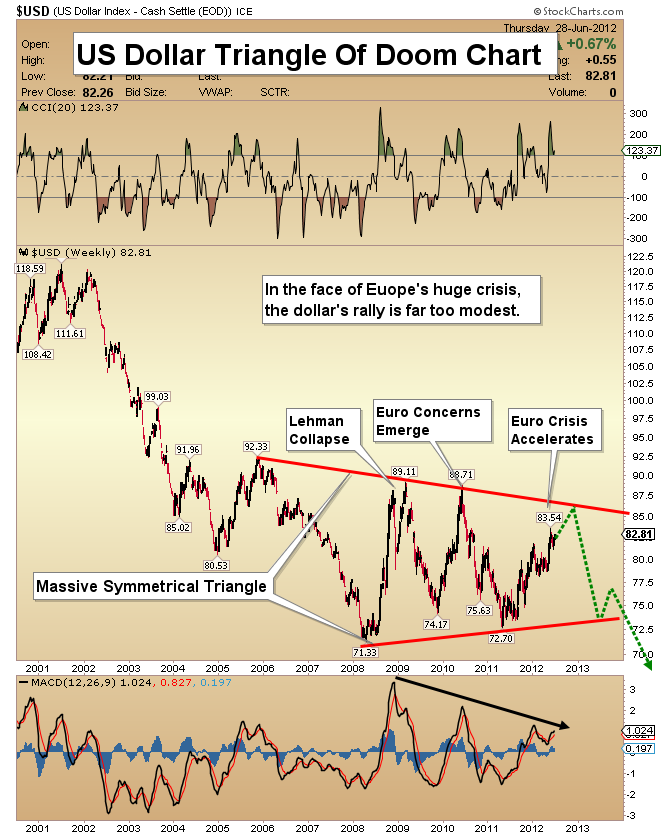
US Dollar decline technical forecast: http://www.gold-eagle.com/editorials_12/images/hubbartt062912a.png

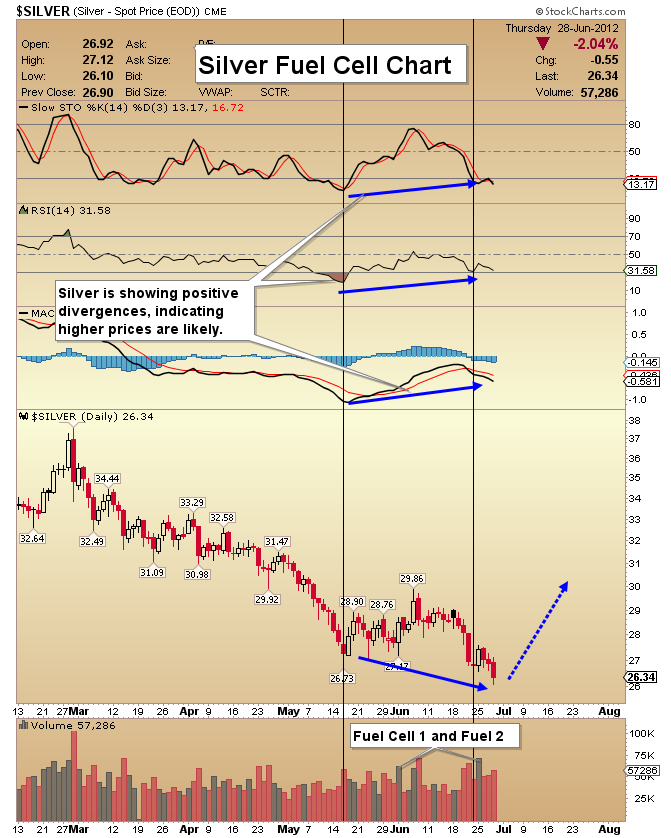
Silver uptick: http://www.gold-eagle.com/editorials_12/images/hubbartt062912g.png

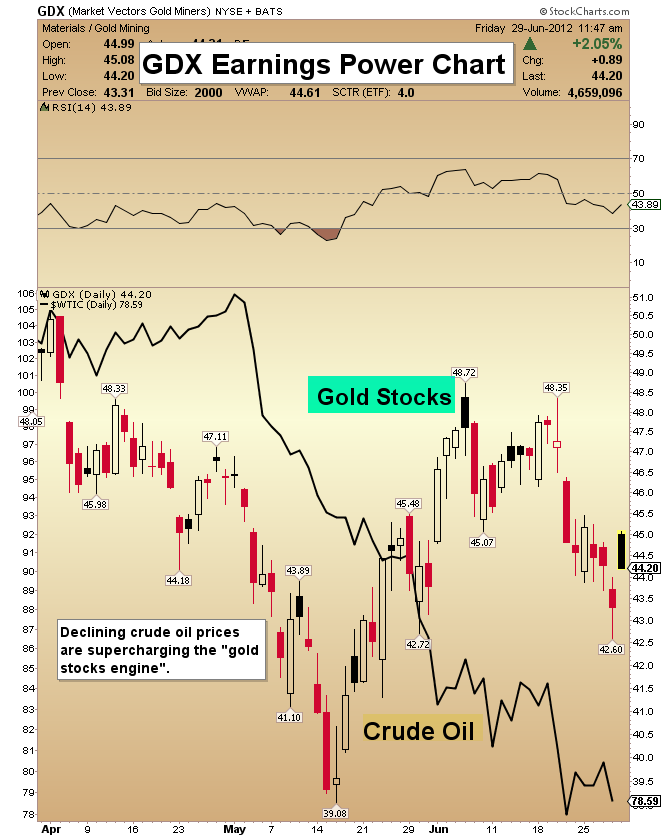
Crude Oil decline fuels Gold uptick: http://www.gold-eagle.com/editorials_12/images/hubbartt062912e.png


Sunday, November 27, 2011

Preserving Wealth Against Higher Volatility

Too many times, the imagination of constant behavior has led us down a path of financial ruin. The thought that housing prices will always rise or the belief that dot com companies will continue a path of infinite valuation growth, propped up bubbles that left everyone involved (directly and indirectly) in a world of hurt.

The focus of this post is on those that are indirectly involved - the pension holders, mutual fund investors,  hard working individuals wanting to secure their wealth. Often times, these people just go with the flow and fail to take full control over their investments. For example, pension schemes are designed to make gains during bull markets, and remain steady during down-times largely through the hope that people will continue paying into the system. Volatile times call for greater optimization of portfolio returns to get out of the rat race of traditional investing.

Stop being a blind investor. It's time to take charge.

Buy and Hold is a common term in portfolio management. An investor picks an asset or a basket of assets with the intention of holding on to it for a long period of time. This is a gamble. You hope that your due diligence conducted now will grant you time without worry in the future. Sometimes this works. Investors stick with major companies like WalMart and even Apple for long periods of time and make significant gains in their portfolio. However, those that actively re-balance their portfolio are one step ahead, and are more secure than the buy and hold investor.

A portfolio should be diversified by industry (or asset type) and time of investment. Investors should have a mix of assets that have various time frames associate with the trade. One might invest in Apple for two years (with periodic check-ins and adjustments), but also invest in Oil and Gas only during specific conditions such as storage reports. The former involves less transactions with a clear eye on maintaining value, whereas the latter calls for a trading approach to handle long term uncertainty with short term gains.

This is an ongoing balancing act. Simple diversity in asset classes will only go so far. Investors need to look at the snapshot scenario. If an investor is focusing on a particular market condition - say the European debt crisis, correlation between assets must be managed properly. A naive investment -- placing large bets in the US equities markets hoping that this will protect your portfolio from European exposure.The problem here is that US companies have great exposure to Europe as it is a major trading partner; better hope you're not holding financial stocks that have a balance sheet full of Greek debt.

Investors need to understand that investing in Mexico is parallel to investing in the US. Placing money in Asia does not guarantee safety from the economic woes of the West as trade and financial dependence is evident. Investing in Australia without understanding Asia can be fatal (when China demands less, Australia suffers). The bottom line is that your portfolio needs to take a constant pulse of various conditions inside and out of your asset classes.

Another naive approach is to give up and avoid the global recession by investing in Gold for the long haul and be completely blindsided to scenarios that may play out. Investors can only prop up Gold prices for so long as the demand for liquidity to cover risky positions in equities will cause periodic moments of declining Gold prices. In the long run, gradual price rises may correct this, but based on your financial position, a margin call might drain your portfolio in its entirety. Short term speculation in smaller amounts will allow investors to cash in where they see opportunity. It requires more time and awareness, but your money deserves some attention. A lazy investor receives lousy returns.

The video above is from the video bar provided by Merrill Lynch Wealth Management. The panel of experts speak to this point very well.


Sunday, October 9, 2011

Inside Operation Twist: Trading like the Feds

Here's a quote from a past article featured on this blog:

The treasury bails out troubled banks, while the Fed funds these bail outs by purchasing attractive treasury bills. The return on interest and added bank fees for insurance serves as revenue for the Fed, in which about 80% is given to the Treasury. So, I beg to question the motives of these politicians. I support Bernanke's fight to keep the Fed independent. -Dantes Outlook

Trading like the Fed during these times might involve something more sophisticated  than an average FX position. The dollar is busy saving investors from Europe, and in the long run the effects of Operation Twist will probably not be evident in the FX markets as conditions change frequently.

Look towards the financial futures market. Second in size to the global foreign exchange market (FX), the financial futures market trades at such massive scale equal to about 1/2 of US GDP. It is expensive to participate here (thousands of dollars) but positions are generally longer term and only trade about 4 times per week.

Here's a strategy: (NOTE -- currently studying this for my degree)

Implied yield on T-Bond contract is around 5.66%. Implied yield on Eurodollar CD is around 2.62%. Let's aim for the T-bond to get 50 basis points above the Eurodollar CD rate.

For this 50bp spread to occur, this needs to happen:

3.12% - 2.62% = 0.50%  long term (or 2.62 + 0.5 = 3.12)
5.66% - 5.16% = 0.50%  short term

Thus, the T-bond futures contract will need to rise enough for the implied yield to fall to 3.12% as operation twist should command. Using a spreadsheet model, you can play around with the prices to find a comfortable yield that will move the price closer to present value. Refer to the chart below for a visual breakdown.

*Check out the brochure to learn more about custom strategies (FX trading for now) in the Research & Advisory Section.


Saturday, September 24, 2011

Markets Prepare for Downside Risk

The markets experienced lots of turbulence this week following Fed Chairman Bernanke's plan for more easing. However, that alone was not the major worry among investors. It's the growing concern that rescue initiatives are exhausted, leaving everyone forced to make key decisions that avoid risk.

As IMF Chief Lagarde accurately puts it, "[there are] downside risks on the horizon, they are piling up." Everyone knows this, but it seems that investors are the only ones making the necessary bold moves, sending shocks throughout the financial system. As more rhetoric fills the airwaves from political officials, the more investors and common folk lose trust in the system. At this point, it's actually good. These officials have got us into more economic trouble, and perhaps it's best they continue to talk and not act. Let the markets do the work.

For sure, we always expect more of the same to come out of these talks - things like QE3 or more bailouts. Bernanke's long awaited speech and FOMC decision did not live up to the hype. The markets expected a grand program of more quantitative easing (heavy purchases of treasury debt to encourage more lending and spending). Instead, Bernanke did not come to the rescue, and proposed a lighter adjustment to the Fed's gradual withdraw of monetary stimulus. There will be more purchases than planned, but still less as the months go on. The Fed is exhausted, and Bernanke is pressuring Congress to take  responsibility for the fiscal problems in the US.

These grand expectations caused investors to scramble for liquidity. As Gold prices rose in anticipation of QE3, it declined following the announcement of Bernanke's 'operation twist' as investors sold gold positions for cash to cover losses in risky assets like stocks. These margin calls require more cash on hand to cover greater risk. There is also an opportunity cost for holding gold (storage), so during cash-strapped times, it makes sense to just sell this liability and seek hard cash coupled with income generating assets like treasury bonds. The dollar was also heavily bought for added security as Europe faces heightened risk of a Greek default. Italy's downgrade added more fuel to the fire. Here's a breakdown of the market's reaction:

  • Gold dropped 5.7% on Friday, down 9.6% for the week to 1,638/ounce
  • Silver down 18% on Friday (was highly overbought before 'operation twist' announcement..also industrial use of silver is more of a hassle to hold).
  • Dow down 6.4% this week, but up 37 points on Friday to 1,0771 (cash from gold/silver sell-off put back to cover equity positions).
  • Euro down 6% this month, ended week at 1.35
The markets show the flow of dollars in response to the economic politics of the world. It's the strongest indicator that we have. 

Europe is still examining ways to lend Greece more money. 15 billion euros ($20 billion) has already been allocated to Greece until 2013. The request for more euro's comes at a cost -- the country must enact tougher austerity measures. The problem with this is that austerity will cause a slowdown as more financial pain is placed on the people of Greece, and crucial services that have the potential to revive the economy are receiving cuts. Transit workers recently staged a massive strike in protest of cuts, grinding the system to a halt. Greece will need an investment plan coupled with incentives making full use of its resources. 

China is not coming to the rescue of Europe, especially Greece. It knows that the bailouts and political dithering are clouding the structural reforms so desperately needed. China is in seek of return on investment if it does provide some assistance; Europe is not in the right position to provide a return. A free check will not come from China; the IMF, G20, and European Stability Fund handle the unsustainable flow of aid. 

China is busy handling its own problems - withdrawing stimulus which caused domestic problems such as a construction boom, 6%+ inflation, 7% growth targets (lowered from the 8-9% trend), and local debt issues which call for tighter lending standards going forward. 

The world can no longer depend on China, bailouts, stimulus, etc to solve its problems. The markets need to be accepted as a sustainable alternative. The Australian dollar has been on a decline recently as weak economic data out of Asia spread fears about trade volume between China and Australia due to lack of demand for natural resources. Leaders need to fess up and provide sufficient returns for capital injection. 

Wednesday, August 24, 2011

Bank of America, Buffet, and Army of Analysts Shut Down Crooked Henry Blodget Sell-Off

Warren Buffett's Berkshire Hathaway will invest $5 billion in Bank of America 
News broke out this morning, pushing BofA higher after this blog post was published yesterday afternoon, encouraging investors to hold on despite what the pundits say. 

Henry Blodget is the CEO and Editor-In Chief of Business Insider and a familiar pundit on Wall Street who loud mouths for or against tech companies depending on his investment objectives. Now banned for securities trading following some questionable predictions during his internet and e-commerce analyst positions at Prudential and Merril Lynch. Gaining popularity, Blodget offered good calls particularly on Amazon.com hitting his price target of $400 per share, and bad calls in which he labeled eToys as a good long term buy back in 1999 - which eventually tanked two years later and had assets acquired by KB-Toys; perhaps a move to prop up share prices to leverage a sell through indirect trading accounts pointing back to his personal stake. Now ousted from the industry, Blodget remains active - with a new target on Bank of America.

Tech guy turned bank guy, Blodget had great power leveraging his platform at Business Insider and connections with big heads on Wall Street to spread fears about Bank of America being under capitalized with great risk exposure. The fears rippled throughout the blogosphere and investors began shorting heavily. A rumor was sparked about JP Morgan preparing to purchase Bank of America with government cash support. Especially at a time when everyone is worrying about economic slowdown leading to a double-dip, negative attention towards US banks is sure to spark big fear -- another 2008-type crisis? No. Take a breather.

The fundamentals are worrying, but not as scary as Blodget and friends make it seem. On July 19th of this year, Bank of America reported a net loss of $8.8 billion ($0.90 per share), largely due to charges resulting form a recent agreement to resolve Country-wide liens on Residential Mortgage-Backed Securities (RMBS) involving a line of $900,000 worth of loan modifications, repurchase exposures, and other related costs. The bank's core business performance this past quarter was held back from higher costs as management absorbed more mortgage issues. With losses canceling out gains and draining cash, investors have good reason to be cautious.

However, Bank of America continues to experience a good inflow of deposits and revenues gained from those holdings. The bank reported $147 billion of new extended credit in the second quarter, an increase in consumer deposit balances by $44 billion (4% from previous year), and more small business accounts equipped with the support of new branch locations and local loan specialists. An increase in Global Wealth clients contributed to $1.6 billion in investment banking fees, the bank's highest since the Merril Lynch acquisition.

Tangible Book Value (TVB) essentially measuring the net-worth, has decreased by about $1 to $12.65 per share from the first quarter of this year. Since the bank is balance sheet driven, investors can use TVB as a rough estimate of its liquidation value - apparently being low. This is a problem; consistently lower TVBs shows that too much of the banks' interest earning assets are covering interest bearing liabilities. Again, the costs on the liabilities side coming from mortgage loan problems.

The financial short-fall is a natural consequence of addressing the mortgage problems head-on, an organic approach taken on by the new CEO. Brian Moynihan is doing a good job with cleaning up the mess from former CEO Ken Lewis who grew a troubled bank. The fact that this is going on internally is great news for the long term investor. Given no immediate disaster in the economy, Bank of America is preparing a sustainable path for itself.

The big worry among investors is that Bank of America may dilute its shares for immediate cash. Not quite. The internal operating overhaul will provide sufficient liquidity for Bank of America to remain solvent. Moynihan is looking at what works, and what doesn't work. More clients, depositors, fees, liquid interest-earning assets, and sales are working well. A sell-off should not be shunned upon; so far 20 assets have been sold under Moynihan's leadership including the Canadian card unit, plans to exit UK and Irish card units, and write downs of credit cards and mortgage units. The power of a write down - reducing the book value because the asset is deemed overvalued - will help Bank of America adjust to reality and manage its operations better. As with most banks, Bank of America is overstaffed with toxic paper pushers, not value creators. The 3,000 layoffs recently marked a significant move to restructuring operations. Shifting labor from what doesn't work, to what works (hence more local loan officers to monitor small business credit lines during economic uncertainty) is a result of good management.

Trusting Moynihan is tricky, but moving forward will hurt in the short term. The rumors will continue, but those who stick to the fundamentals will gain.  The JP Morgan merger is unlikely as Bank of America already has $62 billion in market cap with enough on its plate. External moves will hurt the company, and it knows this -- investors are voicing their opinion that the company should continue internal restructuring, or else risk a sell-off (with a stock price so low, there's not much room to risk such a blow in equity value).

The risk of being undercapitalized is important, but debatable. Basel III capital requirements will force Bank of America to raise $25 billion, according to JP Morgan (not $200 billion according to Blodget). Here's what the army of analysts say:

-------------------- 

Bank of America (BAC) got a new supporter on Wednesday, as analyst Meredith Whitney told Bloomberg Radio that the hemming and hawing over the bank’s need to raise billions in new capital is overdone. “I don’t think that there’s a mad dash to raise capital immediately,” she said. --Barron's
--------------------                                                     *                                               -------------------- 

"There is no impact whatsoever on Bank of America's balance sheet, based upon the price of its stock in the open market. If the price of the stock goes to a penny a share, it has no impact on the balance sheet of Bank of America. Bank of America sells the stock to the public, it takes in the money, and that is the end of the transaction as far as Bank of America is concerned. If you're going to break a bank, you're going to have a run on its deposits. That's not happening. Exactly the opposite is happening…Deposits are pouring into Bank of America."
"Or, as in the case of the fourth quarter of 2008, you've got to bust a bank by making it repay all of its short-term debt immediately. Bank of America has so much cash on its balance sheet that it can pay back all of its short- term debt, it could pay back a big chunk of its long-term debt and still have excess cash on the balance sheet. You can't break the bank by driving the price of the stock lower, particularly if the bank is as cash-rich as this one is with deposits pouring in as fast as they are." --Bank Analyst Dick Bove
--------------------                                                     *                                               --------------------

Core Portfolio - Prime mortgages 30 days or more past due increased to 1.98% from 1.67%.
Legacy Asset Servicing Portfolio - Subprime mortgages 30 days or more past due increased to 46.7% from 46.6%.
Commercial – Commercial loans 30 days or more past due decreased to 2.01% from 2.55%.
Credit and Consumer – Loans 30 days or more past due decreased to 3.38% from 3.93%.
Also, 90% of the loan portfolio is paying in a timely fashion.
And 8.5% of the loan portfolio is 90 days or more past due or was purchased credit impaired.
If all of these loans default with no recovery rate, BAC would be looking at $75 billion in future write-downs. With $37 billion already allotted to loan loss reserves, the bank would be looking at a decrease of $38 billion from tangible book value, which held steady near $130 billion. That would still leave the bank with over $90 billion in tangible book value and selling for just 75% of tangible book value. Currently, the bank only sells for half of tangible book value, an unprecedented valuation.
For Bank of America to become insolvent, 14% of its loan portfolio would have to default with no recovery rate. With only 8.5% of loans currently 90 days or more past due and/or purchased credit impaired and almost assured to have some recovery rate, this would mean defaults would have to at least triple for the bank to become insolvent, a level much worse than the depths of the recession in 2009. -- Matt Blecker 
--------------------                                                     *                                               --------------------
This is nothing like 2008, says CEO Brian Moynihan. "Simply put, we have twice the capital we did back then," he said on a recent conference call. B of A currently has twice as much capital as regulators require. New international banking standards called Basel III require large banks to hold 9.5% Tier 1 common equity, phased in between 2013 and 2019. B of A says it will already exceed 8% next year. Seven years to raise less than two percentage points of capital is hardly onerous, particularly since B of A isn't paying dividends to shareholders. As for aneverending stream of lawsuits caking the bank in uncertainty, Moynihan said he isn't going down without a fight. --Motley Fool