
Showing posts with label China. Show all posts
Showing posts with label China. Show all posts
Sunday, June 1, 2014
Exports: Latin America and the Caribbean
China will become an important source of growth for the LatAm region over the next decade. A diversified export pattern will help LatAm countries form a genuine strategic partnership with the world's fastest growing economy, according to a recent initiative by the Economic Commission for Latin America. Domestic policy should support industrial growth and commerce that will expand employment opportunities and contribute a wider mix of exports to the global economy.
Smaller Caribbean and African nations are often squeezed out of world trade through unfair competition and suppressed by three negative forces: debt, corruption, and aid. China provides an outlet for trade and economic growth. Despite a slowdown in China, its global resource grab has been resilient. LatAm countries should attract higher levels of Chinese investment as slower end-market demand weighs on raw commodity prices. This will provide a strategic opportunity to expand domestic growth while inefficiencies in China could influence a global quest for yield. The ECLAC initiative is an important first step.

Tuesday, November 12, 2013
Challenges for Australia as China reforms point to slower growth

Despite recent signs of modest economic improvement, Australia is likely to remain on a tightrope for quite some time as the country’s mining boom slows down. Recent economic data from China shows strong improvement, but that could change as leaders are set to implement significant reform measures that could slow growth in the near-term. The market is well aware of the challenges ahead for Australia, and several important risk factors suggest that the Australian dollar is likely to remain subdued, especially as it struggles to sustain a rebound off summer lows.
China’s Third Plenum matters
A four-day, closed door meeting between China’s leaders to discuss the economic and political agenda for the next decade just concluded and expectations are high for significant reform. China must pave the way towards a market economy that will redirect credit away from inefficient state-owned-enterprises (SOEs) to much more efficient private enterprises. The new agenda should loosen the state’s control over capital allocation, which starts with reducing the limits on wealth transfers.
Wednesday, October 23, 2013
Asia Focus: AUDUSD up on Australian CPI but pares gains in Asia
 |
| Australia's housing sector helped boost Q3 figures. Photo: Shutterstock |
Australia’s third-quarter CPI report was impressive despite remaining subdued on the headline print at 2.2 percent on year from 2.4 percent in Q2, which is still at the lower range of the Reserve Bank of Australia’s target of two to three percent for annual inflation.
The market was expecting slower CPI in Q3, but the trimmed mean figure beat consensus at 2.3 percent on year. The Reserve Bank of Australia (RBA) places more weight on trimmed mean CPI, so the recent rise could sustain the RBA’s more favourable tone on the economy.
Furthermore, the Q3 Aussie CPI report showed a greater contribution from the housing group, which suggests that recent data are starting to reflect the low rate environment. The RBA is now watching the higher AUD.
Also, top China banks tripled debt-write offs as investors fear default. The seven day repo rate rose 42 basis points in Asia which; lingering fears on banking -- China's weak-spot, was behind the sudden AUDJPY drop during the Asia session. Key China PMI data ahead on Thursday to watch for as well.
Continue reading at Saxo Bank's TradingFloor.com
Trade Idea: Buy-the-dip opportunity in AUDUSD
Friday, October 11, 2013
Australian economy modestly improved but still fragile

The Reserve Bank of Australia (RBA) softened its dovish view on the economy after the summer when headlines of a possible soft landing in China and declining terms of trade shifted the focus onto the vulnerable Aussie dollar. AUDUSD sustained a nice rise after recent China data came out ahead of market expectations, but domestic data did not suggest that Australia was out of the woods.
That could be changing now as recent confidence and employment data point to a modest improvement, which could keep the RBA satisfied for the remainder of the year at least.
Thursday, April 11, 2013
Economic Update - Are we in transition mode?
There is still an air of economic uncertainty in the US, but there is hope. Hope that this year will mark the start of a recovery. The struggle to reach that point places an emphasis on the string of economic indicators and the reality behind them. We know that the Fed is keeping a close watch and is considering its options should the economy show signs of strength later this year.
March FOMC Minutes
The latest minutes were released early to several high ranking officials and the joke goes that if they can't get an email right, what makes us so sure that they can get the timing of a QE exit correct. Nevertheless, the minutes for March were released to the public during the morning hours EST instead of the usual afternoon time. It showed the evident discourse among FOMC members about when the phase out of the controversial and much extended QE program (reaching a record $3.22 trillion) will occur. We get a feeling that the consensus is for later this year when some economists expect a pick-up in the US economy.
Even still, members said that if labor market conditions improved as anticipated, it would probably be appropriate to slow purchases later in the year and eventually stop by year-end. There is still the possibility of returning to QE-lite because uncertainty still lingers, and the Fed might feel the need for continued support.
The debate over when to put a nail in the QE coffin is nothing new. The past few minutes have brought to light the concerning nature about balance sheet risk and the economy's ability to continue growth without the artificial push. The first mention of this was back in Q4 of 2012 which sparked an immediate stock market sell-off. Now, investors are aware of the ageing QE program, to the point where recent attention shifted to negative news from Cyprus which then caused a plunge in treasury yields.
The Breakdown
We can't ignore the healthy rise in equities. Some wonder if it is inspired by QE or just last minute bids on a general fear of missing out on some good gains. The fact is that QE has shifted asset allocation away from the usual safe-havens and stimulated a risk-on investment environment. But we have to take a step back and remember the fundamentals behind the recent low from early this year in which equities used as support for a rally. Stock market gains are not matching earnings and economic data, which suggests that a mix of sentiment and the quest for yield is the driving force. The stock market was bogged down with debt ceiling and fiscal cliff bickering at the start of 2013 which created a good buying opportunity. Technicals looked right and investors took advantage of the dip.
A deeper look into the economic fundamentals display some evidence of a transition to recovery. We see wealth gains mainly in the form of equities and a pick-up in housing construction and building activity. Consumers are still deleveraging which allows for spending. For example, refinancing could mean that savings are free to be allocated to more productive areas such as home improvement. A deeper look into the data gives us an understanding of how consumers are economizing during the economic transition.
Consumer debt has dropped to more comfortable levels, and credit can pick-up to reflect some confidence in the consumer's ability to borrow. However, the employment picture looks bleak. With a significant decline in labor force participation and a stagnant low-wage environment, there is little evidence to support a healthy labor market. Most of the activity is coming from the capital side of the growth equation. The fact is that most are under-employed and we are seeing households stick together - income sharing to phase out the negative in anticipation of a return to normalcy in which every member of the household is fully employed and self sufficient. Until we get there, a lot of the data might reflect only a half-truth.
We also have a demographic battle in which economic activity is missing the matriculation of first time buyers and the fresh labor pool of earners and spenders. The stark reality is that student debt is holding back the younger population resulting in higher defaults and the lack of entry level opportunity that is commensurate to the cost of study. Close attention to the Northeast housing and consumer market will be an important indicator to track this, as a great share of college graduates populate that region.
China marches back, but the West still looks ill
Good China trade and industrial data caught investors by surprise. There is a renewed sense of optimism in emerging markets overall. But some concerns over China's local debt problems and demographics keep the longer term outlook on a tightrope. The hope is that the new government will be quick to address these issues.
We will need full strength of the West for a clear sign of a global pick-up. Europe still looks weak with new sprouts of headline cases like Cyprus still in the mix.
The uncertainty is still there - look at the peso's fall against the greenback on Thursday as a signal that there is some concern about the ability of the US to boost the global economy. The Americas need the demand from the US, and LatAm markets can be an important indicator for foreseeable strength in terms of trade.
Long term view relies on current policy action
At some point, we will see sustained growth. Whether it starts later this year or rolls into 2014, there is evidence of transition and signs of hope. But the real question is how will we be able to keep the economic engine going.
Take a close look at the coming budget negotiations. Approach the issue with a clear mind and hear out both sides. Compromise on a long awaited budget will pave the way. We desperately need a framework to guide us through a recovery, or else we will get more of the same out of control spending and borrowing. There is doubt that whatever deal is reached, it will not be enough to address the serious fiscal deficit issue and economic folly that is inherently structural.
Immigration should be an important focus to keep the US as the most reasonable place to innovate. Innovation is part of the global market, and we must remain competitive. Higher education is taken up by more foreign students who will be at the helm of the growth. Look at Canada's latest plan for guidance.
Lastly, there is belief in the states. Despite underfunded pensions and liability short-falls, states have been busy strengthening their fiscal position. Most states are in a good cash position and the supply of municipal debt has declined. Investors are starting to see less risk, and the latest Census data shows an increase in state tax revenues. The revenue plans are highly strategic and take advantage of areas of productivity such as drilling out West. Some regions of the US are doing far better than most, and perhaps there's a good model out there for solid growth.
March FOMC Minutes
The latest minutes were released early to several high ranking officials and the joke goes that if they can't get an email right, what makes us so sure that they can get the timing of a QE exit correct. Nevertheless, the minutes for March were released to the public during the morning hours EST instead of the usual afternoon time. It showed the evident discourse among FOMC members about when the phase out of the controversial and much extended QE program (reaching a record $3.22 trillion) will occur. We get a feeling that the consensus is for later this year when some economists expect a pick-up in the US economy.
Even still, members said that if labor market conditions improved as anticipated, it would probably be appropriate to slow purchases later in the year and eventually stop by year-end. There is still the possibility of returning to QE-lite because uncertainty still lingers, and the Fed might feel the need for continued support.
The debate over when to put a nail in the QE coffin is nothing new. The past few minutes have brought to light the concerning nature about balance sheet risk and the economy's ability to continue growth without the artificial push. The first mention of this was back in Q4 of 2012 which sparked an immediate stock market sell-off. Now, investors are aware of the ageing QE program, to the point where recent attention shifted to negative news from Cyprus which then caused a plunge in treasury yields.
The Breakdown
We can't ignore the healthy rise in equities. Some wonder if it is inspired by QE or just last minute bids on a general fear of missing out on some good gains. The fact is that QE has shifted asset allocation away from the usual safe-havens and stimulated a risk-on investment environment. But we have to take a step back and remember the fundamentals behind the recent low from early this year in which equities used as support for a rally. Stock market gains are not matching earnings and economic data, which suggests that a mix of sentiment and the quest for yield is the driving force. The stock market was bogged down with debt ceiling and fiscal cliff bickering at the start of 2013 which created a good buying opportunity. Technicals looked right and investors took advantage of the dip.
A deeper look into the economic fundamentals display some evidence of a transition to recovery. We see wealth gains mainly in the form of equities and a pick-up in housing construction and building activity. Consumers are still deleveraging which allows for spending. For example, refinancing could mean that savings are free to be allocated to more productive areas such as home improvement. A deeper look into the data gives us an understanding of how consumers are economizing during the economic transition.
Consumer debt has dropped to more comfortable levels, and credit can pick-up to reflect some confidence in the consumer's ability to borrow. However, the employment picture looks bleak. With a significant decline in labor force participation and a stagnant low-wage environment, there is little evidence to support a healthy labor market. Most of the activity is coming from the capital side of the growth equation. The fact is that most are under-employed and we are seeing households stick together - income sharing to phase out the negative in anticipation of a return to normalcy in which every member of the household is fully employed and self sufficient. Until we get there, a lot of the data might reflect only a half-truth.
We also have a demographic battle in which economic activity is missing the matriculation of first time buyers and the fresh labor pool of earners and spenders. The stark reality is that student debt is holding back the younger population resulting in higher defaults and the lack of entry level opportunity that is commensurate to the cost of study. Close attention to the Northeast housing and consumer market will be an important indicator to track this, as a great share of college graduates populate that region.
China marches back, but the West still looks ill
Good China trade and industrial data caught investors by surprise. There is a renewed sense of optimism in emerging markets overall. But some concerns over China's local debt problems and demographics keep the longer term outlook on a tightrope. The hope is that the new government will be quick to address these issues.
We will need full strength of the West for a clear sign of a global pick-up. Europe still looks weak with new sprouts of headline cases like Cyprus still in the mix.
The uncertainty is still there - look at the peso's fall against the greenback on Thursday as a signal that there is some concern about the ability of the US to boost the global economy. The Americas need the demand from the US, and LatAm markets can be an important indicator for foreseeable strength in terms of trade.
Long term view relies on current policy action
At some point, we will see sustained growth. Whether it starts later this year or rolls into 2014, there is evidence of transition and signs of hope. But the real question is how will we be able to keep the economic engine going.
Take a close look at the coming budget negotiations. Approach the issue with a clear mind and hear out both sides. Compromise on a long awaited budget will pave the way. We desperately need a framework to guide us through a recovery, or else we will get more of the same out of control spending and borrowing. There is doubt that whatever deal is reached, it will not be enough to address the serious fiscal deficit issue and economic folly that is inherently structural.
Immigration should be an important focus to keep the US as the most reasonable place to innovate. Innovation is part of the global market, and we must remain competitive. Higher education is taken up by more foreign students who will be at the helm of the growth. Look at Canada's latest plan for guidance.
Lastly, there is belief in the states. Despite underfunded pensions and liability short-falls, states have been busy strengthening their fiscal position. Most states are in a good cash position and the supply of municipal debt has declined. Investors are starting to see less risk, and the latest Census data shows an increase in state tax revenues. The revenue plans are highly strategic and take advantage of areas of productivity such as drilling out West. Some regions of the US are doing far better than most, and perhaps there's a good model out there for solid growth.
Wednesday, October 3, 2012
Long term troubles for the US and Europe despite year end breather. Who will win?
The events of the past few weeks suggest that a forceful attempt to get things right by year end will only last for so long. The authoritative approach by frustrated central banks; Germany's clever stalling strategy with Spain; and corrections in Canada's housing market, all point to a much awaited year-end breather. This is what we want to see, but the long term outlook is still troubling.
Let's start with Spain.
On Thursday, Spain announced its budget and economic reform measures which includes planned spending cuts for 2013. The government stated that the 2012 revenue target will be met, but plans to tap 3bn euros from the Social Security reserve fund to cover pension payments was quite the shocker.
The fact that the demographic make up of Spain skews towards the elderly, coupled with high youth unemployment means that these crucial reserve funds are not growing at a sustainable rate to accommodate the pace of payouts. Austerity measures will lead to further slowdown with no major growth in employment, and Spain will need to find a way to meet its liability needs; a larger pool of government dependents being one of them. Policymakers need to remember that most Spanish households actually rely on the retirement payments from the elderly family member to stay afloat.
Sunday, September 16, 2012
Bank of Canada dovish on Western friends, positive on China
On September 7th the Bank of Canada issued a report concerning the dutch disease; with Governor Carney's remarks intended to ease concerns about the high Canadian dollar's adverse effect on trade sensitive sectors. However, the report failed to address how policy makers will respond to Canada's growing troubles in manufacturing productivity and inflated housing sector. Instead, the report shared some insightful information on the BoC's negative outlook on the US and Europe. Canada is strategically aligning its economy to meet the long term resource demands of the emerging world, most notably from China.
Canada's global projections are on point and deserve greater attention. It is in Canada's best interest to remain well informed about the global economy.
Canada's global projections are on point and deserve greater attention. It is in Canada's best interest to remain well informed about the global economy.
Tuesday, August 28, 2012
Soft Landing Ahead for Housing Markets in Canada and Australia
Global housing prices rose steadily from 2001 to about 2008 when the bubble eventually burst in the US. The problems in the US were a special case as a growing system of over-leveraged banks fueled by government subsidized guarantees led to a hard landing. During this time, resource driven economies such as Australia and Canada experienced a minor correction. With prices continuing to rally despite global deleveraging, China's major trading partners will bear the brunt of a soft landing. However, China's desperate need for resources will stabilize the imbalance.
 |
| The chart above clearly shows Australia, Canada, and Hong Kong being stubborn to the US correction post-08. Hong Kong's prices have risen sharply due to artificial demand as part of China's economic plans. Expect a major correction soon; stabilized afterward as China undergoes more "laissez-faire" economic reform. ** Click here for full interactive chart. Look at Sweden and South Africa! Poised to pop soon. ** |
Canada's Banks are Well Positioned, But Worries Remain
Monday, July 23, 2012
Time to Buy Silver
via the Dantes Outlook Facebook Page
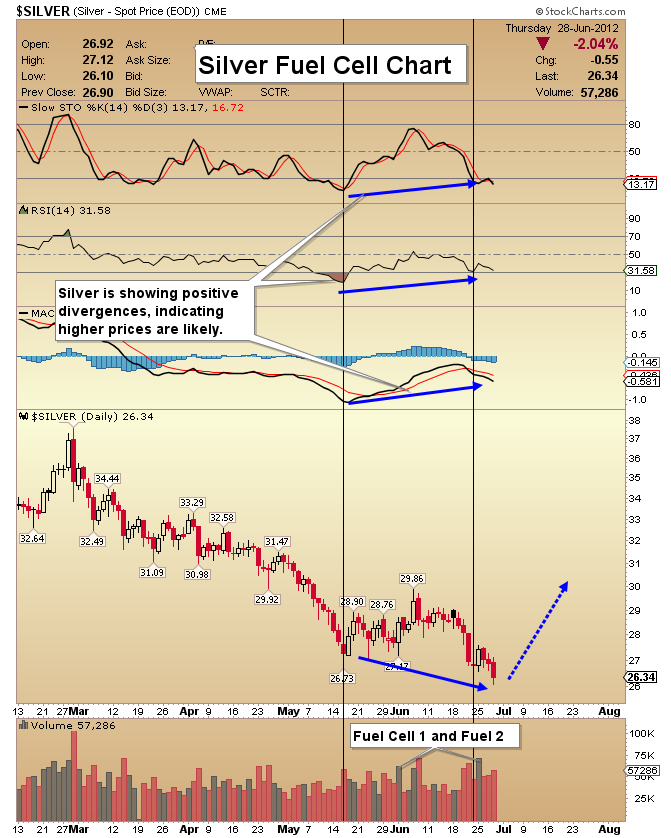
As Western economies attempt to avoid a double dip, the slowdown has formed an attractive buy price for Silver (SLV) at $27. However, easing tactics will increase fears of inflation, and China’s international development strategy is sure to fuel a Silver (SLV) rally to $45.
The global economy is on a tightrope. Growth is on the agenda, but structural issues continue to deter a comeback. Asset buying programs are in full effect, and currency depletion in the developed world will surely cause inflation. However, the downward spiral creates opportunityfor investors. Consider the events of the past two weeks as proper causality to the coming silver rally.
Past headlines were flooded by what seemed to be a coordinated easing tactic by central banks. The ECB decreased interest rates to 0.75% and cut the overnight deposit rate deeper into the zero territory, joining the US and Japan. The Bank of England announced QE measures, a bond buying program meant to increase lending to jumpstart the economy. News out of China demands greater attention for our purpose of being bullish on Silver. China’s slowdown is meant to decrease demand for building projects, thus causing a decrease in the price of Silver and other basic materials. Silver’s four month decline was driven by the fear of decreased demand.
Despite China’s slowdown, we must remember that even 7% growth is good. Citing a prolonged Chinese slowdown is completely short-sighted. The country’s domestic economy is need ofimprovement, but international investment is booming, and will surely add to the demand forbasic materials. China’s easing measures such as decreasing the benchmark borrowing cost will fuel growth at home, while promoting an aggressive international investment strategy. Partnerships with Argentina and Tunisia for building projects in return for access to agriculture and crude oil must not be forgotten. Furthermore, the ability to supply materials highlights a more specific investment opportunity.
iShares Silver Trust, ETF (SLV) is a less risky bet. Pricing at $26.48 at the time of this report, provides a good discount for a buy opportunity. Keep in mind that SLV is stil lpositive for the year despite the four month decline, reversing from a February peak when China reduced its growth target. In terms of meeting Silver supply, consider First Majestic Silver Corp(AG), a silver producing mining company based in Mexico. AG has an aggressive developmentand acquisition plan to produce 8-9 million ounces of pure silver production this year.
First Majestic is rapidly growing, and its strategic location and timing of extraction is key to meeting demand while benefiting from the coming Silver price rally. AG operates 3 productive mines, and has 3 under development. On May 22nd, AG issued a technology report and pre feasibility study of its Del Toro Silver mine. By 2014, the estimated production at Del Toro is expected to reach 9.7 million ounces of pure silver. The development requires $124 million of capital, and is forecasted to produce a 43% IRR over a 6 year production life and a 2.5year payback. Accounting for the upcoming speculation once Silver pops, knowledge of AG’sdevelopment plans and positive studies will be factored into the stock’s rally, heavily correlated with SLV’s uptick.
AG is in a strong financial position, with little debt and positive cash flows to help aid expansion. The only negative on its balance sheet is exchange rate risk.
To recap this buy recommendation, I am confident that SLV and AG will rally due to the continued economic decline of the Western economies. Demand and speculation will drive the rally. China’s international development investments to capture resource wealth will require material usage, and the easing programs of the West will devalue currency and lead to inflation.
A potential negative is if China continues a decline and does not demand materials. The globa lslowdown could continue to bear down on the price of Silver. However, the charts strongl ysupport a buy opportunity.
Here’s the gameplan:
AG is right around the $15 support level, and has the potential of rallying to $20.
SLV is also around a critical support area at $27 and has the potential of rallying to $35-40,holding on near the $45 resistance level. See charts below.*Time horizon for buy is 4-6 months, reaching the $40-45 price level in SLV.
-Damanick Dantes

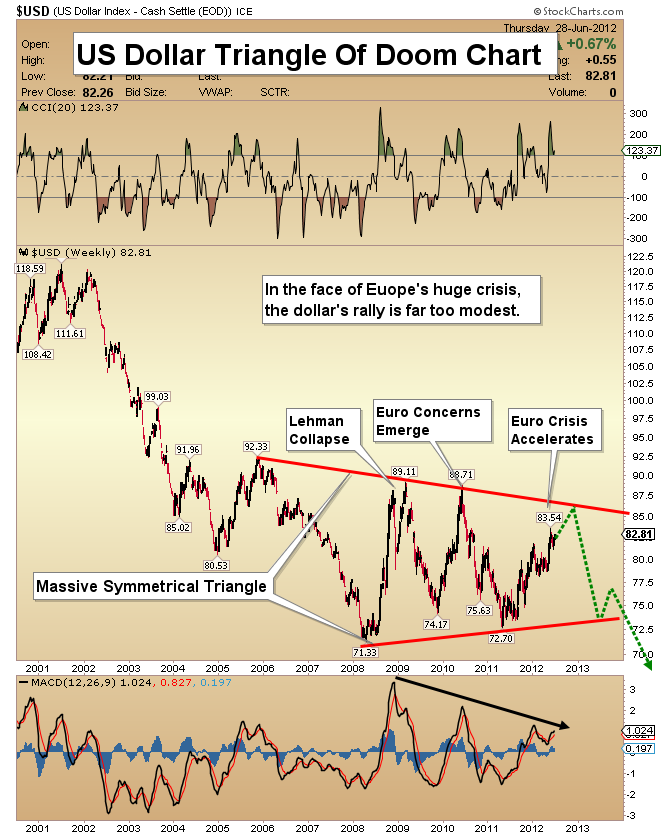
US Dollar decline technical forecast: http://www.gold-eagle.com/editorials_12/images/hubbartt062912a.png
Silver uptick: http://www.gold-eagle.com/editorials_12/images/hubbartt062912g.png
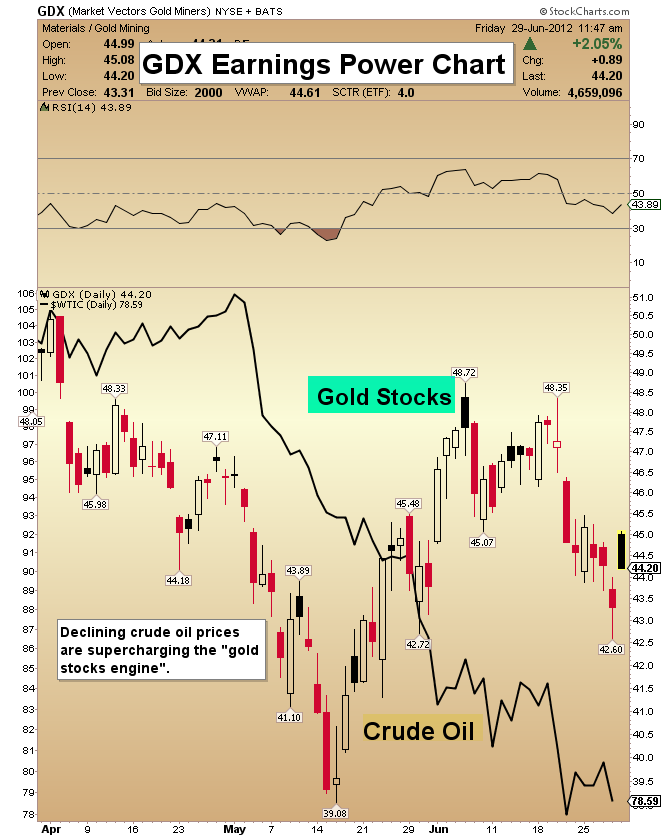
Crude Oil decline fuels Gold uptick: http://www.gold-eagle.com/editorials_12/images/hubbartt062912e.png
Thursday, November 10, 2011
Keystone Pipeline Delayed Until After Election Year
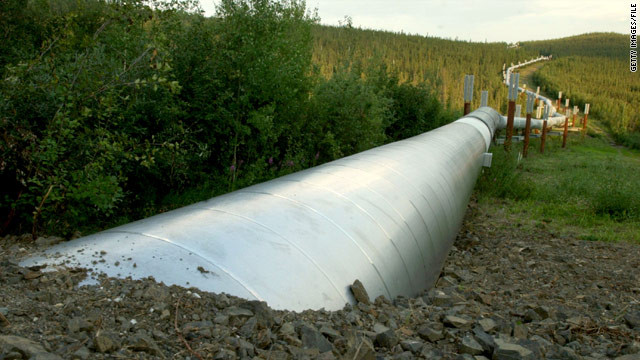
The current Keystone pipeline starts in Hardisty Canada and extends down the US mid-west belt to St.Louis. The proposed Keystone XL pipeline project will push westward, passing through the borders of Nebraska's Ogallala aquifer to reach the southern tip of Houston Texas and Port Arthur Louisiana. The estimated $7 billion project has been in talks for decades, and the US government was supposed to follow a schedule of 12-18 months of logistic, economic, and environmental studies.

Aside from the fact that the US clearly does not have an energy plan, it's also puzzling as to why the government allocates so much time for review and political strategy, but does nothing in preparation for new projects. It would be logical for the US to beef up safety precautions such as engineering barriers and enhanced filtration to make way for a project that is sure to develop some ROI for the neighboring states. Issuing a municipal bond to bring the infrastructure project into fruition, while paying back those bondholders with revenue generated by industry productivity is a solution that makes sense. We need a collaborative approach to work around constraints to maximize capital, labor, and productivity resulting from the pipeline project. Canada deals with the production, the neighboring states deal with optimizing economic gain from the pathway, and Houston and Port Arthur deals with the inflow of oil sand crude and delivery to the nation.
Another year of bickering does nothing when no one is willing to get serious. Canada must be laughing in a field of oil sands right about now. We can't blame them.
Thursday, February 17, 2011
Data Shows China Can Withstand Droughts

Chinese wheat dynamics, 2009-10 (annual change) according to USDA
Production: 114.5m tonnes (+1.8%)
Imports: 800,000 tonnes (+67%)
Use: 103.0m tonnes (+0.5%)
Year-end stocks: 60.0m tonnes (+23%)
Sunday, February 6, 2011
Hushed Data Shows China's Rapid Demand for Agriculture

China's January PMI readings dropped to 52.9, below forecasts of a moderate decline of 53.9, signaling a slight drawback in manufacturing. However, PMI numbers were kept within a tight 51-55 range throughout 2010. Industrial orders are expected to remain in this range because of a domestic pullback as the Chinese government controls industrial expansion. Meanwhile, the strategy is to leverage inflation and fuel the agriculture markets even more.
Fifty years of history show sufficient supply of corn to meet domestic demand in China. As time passes, imports tend to increase. According to the Financial Times, from 1978-79, China imported 3m tonnes of corn. From 1994-95, imports increased to 4.3m tonnes. The US Grain Council released data from unnamed sources that show China's shortage of 10m-15m tonnes of corn. Usually, the Chinese government keeps 30% of corn in stock, but sources say that that the government will only demand 5% in corn holdings. This means that China will need to tap the trade market for 9m tonnes of corn.
The strategy will surely increase the world's dependency on Chinese demand. As inflation increases their purchasing power, which will then fuel domestic demand, China will continue to be a strong trade participant. The game shift to agriculture is expected to prevent future economic shocks of inflation, which many investors worry about. Increasing imports of agriculture will increase supply, and thus decrease food prices in China. The current large demand for food in all developing countries places heavy pressure on production - but supply constraints brought on by weather, raise prices. China realizes this, but has a plan to make it work.

Some analysts worry that the currency appreciation of the US Dollar and Aussie will affect trade with China. But, the Yuan is also rising, increasing China's purchasing power. Australia and the US have farm subsidies to help offset this risk.
Expectations of wheat imports are up because of the worst drought in 60 years in the Shandong region of China. According to China National Radio, unnamed sources provided data that suggest China's imports of wheat to exceed 114.5m tonnes. Dantes Outlook reported our findings of a recent order from China to the tune of 150kt in feed wheat from Australia - 3 cargos of shipment from March-April. The demand is intense, and the opportunities for investors are clear.
All eyes are on Australia, with stronger growth forecasts. The RBA stated that economic activity is expected to expand at an annual pace of 4.25%. The increase in industrial and agricultural production will fuel employment, which will then equate to stronger household spending. Traders are busy factoring in their expectations for an RBA rate hike sometime this year - chances are after the natural disaster damages ease.
 |
| AUD/USD Daily Chart. Clear point of entry for a long term trade considering the due diligence of this post. |
Sunday, December 12, 2010
China's Upcoming Rate Hike and its Ripple Effects

China's growth did not derive directly from trade; the problem is domestic. The country's lax monetary policy, tax code, and currency manipulation have contributed to the current property boom.
Rapid construction fuels Chinese demand for commodities, boosting imports, and adding to export productivity in Australia and Brazil. China's trade surplus narrowed by $22.9 billion in November. A drop from 16% in October, then facing a $27.2 billion surplus. Since then, exports are up by 34.9%, while imports remain higher at 37.7%.
China's trade deals with its South Pacific friends have contributed greatly to the regions trade productivity. So much so, that the Australian dollar basically mimics China's economy; the value of the Aussie essentially being dependent on China's demand for natural resources. Brazil is also a hot bed of commodities, and recent deals with China have accelerated South America's export growth. However, China's domestic problems have spread to its trading partners.
Australia and Brazil have property booms of its own. On a much smaller scale, Australia's expansion is almost a mirror image of China's. Much of Australia's property boom is located in urban areas like Melbourne and Sydney. However, the inverse with China is that much of Australia's property boom is in developing cities like Perth. Western Australia holds a large sum of the country's mineral deposits, and the mining industry contributes to job growth, heavy construction which adds value to land, new homes to house the influx of workers, and now a population glut with immigrants flocking to Australia to capitalize on its growth. Because of this, Australia was among the first to raise rates, and continuing to do so.
In China, much of the growth is in-equal. The housing boom is on the eastern shore in the tightly enclosed urban areas. The western part of China remains sluggish, with a large elderly population.
The US almost seems isolated from this. Not so much. Our trade gap has narrowed with China, with exports up around 8%.
With expectations of a Chinese rate hike, Gold prices are down 2% on the week. US Crude Oil Futures are down 1.57%. The Australian dollar, despite having a nice rally, is set to decline - rate hike lowering the value of the Yuan, thus decreasing China's purchasing power for commodities. If the Chinese government shifts focus to domestic issues, they will need to demand less and tighten monetary policy to cool the housing market. This will also ease trade productivity. In sum, expect the Aussie to decline when markets open.
Thursday, September 16, 2010
US Worries About the Trade Politics of Japan and China


It's tough being the reserve currency. The US is stuck in the middle of a swarm of trade capital and currency swings that must pass our way, given that these countries help shine our appeal. It's only fair, right? But everything is artificial with fiat currencies as governments constantly try to stable their value to shift market interest. The two big players are China and Japan, as the US tries to create this master plan for growth. Here's the scoop.
First, the back story.
In June, China decided to break it's peg to the US Dollar. Possibly to break US pressure for a more "market valued" yuan that will allow our dollar to decline and add appeal in the trade market. The goal is to artificially control domestic data impacted by currency valuations. China did state that the yuan's appreciation will be gradual; so in the long run, this will lead to higher prices of Chinese goods. Given that most of the goods currently in the US come from China, the US expects this to cause some added inflation. Of course, if everything works out perfectly. This should also provide us with an advantage to boost production and exports, adding domestic jobs and a flow of foreign cash into struggling manufacturers. Perhaps China's greater purchasing power will steer them towards the US, creating a good relationship that will probably pull us out from economic misery. Yeah, right. The problem is that US companies will most likely shift their business to other Asian countries with low costs (Made in Taiwan, Vietnam, Korea..ring a bell?).
Even though China has since allowed its yuan to appreciate, they have found ways to stunt its growth. The largest banks in China are state owned, and most are busy buying up US assets and treasuries to keep the appreciation stable. Yet, they buy Japanese Yen to diversify their holdings. The US is sweating bullets. The Yuan hit a new high against the US dollar on Thursday, rising for 5 consecutive trading sessions. However, Treasury Secretary Geithner argues that the "pace of appreciation is too slow, too limited." A 1% gain in a week for the yuan is not enough; the US wants it to accelerate 20%, a more appropriate rate, sometime soon. China has decreased their holdings of US Dollars, but they're still not out of the game, with their sneaky manipulation. The plan was to create this shift away from US Treasuries so that investors will become more productive given the decreased expectation of return. All the while everyone stays quiet about Japan. Ah, yes, Japan.
China's neighbor guaranteed $300 billion in US bonds. This stabilized intervention is meant to decrease the value of the Yen, given Japan's heavy reliance on trade. The Bank of Japan can implement as much as 35 Trillion Yen of intervention capacity. It's not over. Japan wants to create liquidity, they foresee inflation, and want to reduce debt. The power of the Yen is extremely important for the Japanese economy. But, stabilized intervention isn't necessarily good for our plan in the US. The purchase of treasury is a gimmick that may last for a while. The weaker Yen also made the dollar appreciate, although not significantly much as all eyes remain on China. If anything, this raised our standards for the Chinese to push their yuan in response to global threats to the whole currency re-valuation plan.
The US doesn't want such a large injection to the Treasury pile. The Japanese intervention also helped to boost the value of Gold. The US is stuck - we want to follow the success of
 export driven countries like Canada and Australia who rely on the purchasing power of China. We look at the crisis in Europe and how Germany used the depreciation of the Euro as a way to boost exports and help fuel expansion to bring the region back on its foot. The hard truth is that we might have lost our opportunity, or was there one to begin with? The reserve currency doesn't have the advantage to prolong currency strategy to boost productivity. This, once again, brings us back to the domestic drawing board. A task that so many believe is nearly impossible to handle.
As for the FOREX market, expect the US dollar to advance for a few more days against the Yen. After that, fundamentals will return to play, and the dollar will continue its struggle.
Monday, June 21, 2010
The Effects of China's Yuan Revaluation
 Share
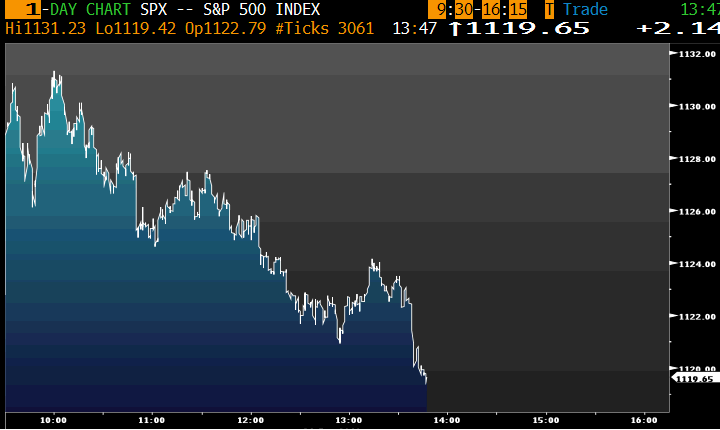
ShareChina's official announcement of their plan to reevaluate their yuan to eventually break its peg to the US Dollar has caused a ripple effect in global markets. US treasuries declined, and other major currencies rose against the US dollar. The chart above displays today's market decline in the S&P 500, as US companies react negatively to higher cost of Chinese goods.
The decision comes just after US Treasury Secretary Tim Geithner pressed China to allow their currency to naturally appreciate, thus allowing the US dollar to appear more attractive. The yuan revaluation benefits China as it gives them more purchasing power. China leads the export recovery, which provided enough reason for the Australian and New Zealand dollars to rally in response.
The US will benefit in one way from the yuan revaluation in trade. A weaker US dollar in the long run is likely to boost our exports. However, the dollar's demise has returned as major currencies rallied against the greenback. US consumers will eventually end up paying more for Chinese made goods, but don't mistake this for inflation - it's simply a trade balance.
Gold will rally as China shifts their holdings of US dollars. Most importantly, this shift has cause a decline in US Treasuries. China will not buy as much Treasuries as it did before to maintain the yuan's peg to the dollar.
Keep in mind that the yuan revaluation will be gradual, so there is still possibility that this news will subside and European debt concern will come back into play. Many economists say this is a risky move for the US as the cost of Chinese imports will rise. The Chinese realize the benefits for them, they are not so much concerned for the US. The announcement was bound to happen as the Chinese have long voiced concerns for the crumbling US economy.
Chinese industrial companies and commodities will benefit from this gradual revaluation, and demand will pick up from China. This should come as no surprise to those who are already invested in the China demand craze. Dantes Outlook was already prepared; the yuan appreciation just fuels the return on investment.
The big drag in the DOW today were those companies that rely on cheap imports from China.
Saturday, June 23, 2007
WalMart Canada Saves Energy By Dimming Lights!
 Following the previous gender discrimination law suit, WalMart attempts to stay positive with another PR push. The company's latest move is to become "green"! The new "environmentally friendly" WalMart demands smaller packaging containers and now energy efficient store lighting. The move will be better for the company's Canada stores because it will save them money and take away the negative publicity. Curre
 ntly, WalMart has 240 stores in Canada and the new method of dimming lights is expected to save about 4,500 tons of carbon emissions during the summer season. I think that this is a great move for WalMart to become liked by the public. I still think that the company needs some one in charge of ethics but I'm all for the environment and agree with the project. Word on the street is that WalMart will use LED lighting in refrigerators supplied by CREE Inc. which will lower the company's energy use. WalMart states that their mission is not to save money but instead save the environment. Go WalMart!
**********STREETBLABBER APOLOGIZES FOR THE UPCOMMING LAPSE AT WHAT IS DEEMED TO BE AN EXCITING ACCOUNTING PROGRAM HELD AT PACE UNIVERSITY!!!! I WILL BE GONE FROM SUNDAY, JUNE 24TH TO THURSDAY, JUNE 28TH***************
Subscribe to:
Posts (Atom)