quotes

Showing posts with label US Dollar. Show all posts

Saturday, April 25, 2015

Pressure to ease as South Korean shares advance

Slower global growth and declining inflation adds pressure on the Bank of Korea to cut interest rates. If the Korean Won depreciates due to lower rates, a boost to exports could follow, which will add further support for Korean equities.

South Korea has joined the Asian stock market rally. The top chart shows a bullish advance in the South Korea iShares ETF (EWY). A pull-back is likely, which could offer opportunity to build positions.

The recent move is supported by improving momentum as the MACD turned positive. The most recent positive inflection occurred near the 2013 bottom in EWY. The MACD histogram (blue bars) is more sensitive to price changes within the longer trend, thereby providing an early signal of an advance at the start of 2015.

The last panel offers confirmation from the Chaikin Money Flow (CMF), a volume-related oscillator. The CMF is a measure of buying pressure compared to the total volume over the past 21 days. The CMF recently turned above zero, indicating the potential start of an upward trend. Further confirmation of sustained momentum is needed if a pull-back (with declining volume) around the 66.00 resistance level nears.


For a technical view of South Korea's KOSPI index, read Nicole Elliott's 4/23 column in the South China Morning Post. Nicole identifies a potential breakout from major long-term resistance going back to 2007.

South Korea (a "closet developed-market country"), is not unique in its latest breakout. China, Japan, and Europe are trending higher on policy support. As investors cover their shorts, expect increased flows outside of the US. This will likely precede a pick up in global growth.

This should be a positive for emerging markets - a group that has evolved to track ex-US/Canada country performance (EAFE index). However, despite the recent counter-trend breakout in the emerging market ETF (EEM) relative to the S&P 500, more confirmation is needed given increasing signs of a pull-back along the long-term downtrend.

Given further confirmation in the months ahead, positive signals from international equities could imply a breakdown in the US Dollar and an advance in commodities -- all of which provide support for inflation.

Wednesday, October 23, 2013

Asia Focus: AUDUSD up on Australian CPI but pares gains in Asia

Australia's housing sector helped boost Q3 figures. Photo: Shutterstock
Australia’s third-quarter CPI report was impressive despite remaining subdued on the headline print at 2.2 percent on year from 2.4 percent in Q2, which is still at the lower range of the Reserve Bank of Australia’s target of two to three percent for annual inflation.
The market was expecting slower CPI in Q3, but the trimmed mean figure beat consensus at 2.3 percent on year. The Reserve Bank of Australia (RBA) places more weight on trimmed mean CPI, so the recent rise could sustain the RBA’s more favourable tone on the economy.
Furthermore, the Q3 Aussie CPI report showed a greater contribution from the housing group, which suggests that recent data are starting to reflect the low rate environment. The RBA is now watching the higher AUD. 
Also, top China banks tripled debt-write offs as investors fear default. The seven day repo rate rose 42 basis points in Asia which; lingering fears on banking -- China's weak-spot, was behind the sudden AUDJPY drop during the Asia session. Key China PMI data ahead on Thursday to watch for as well. 
Continue reading at Saxo Bank's TradingFloor.com

Thursday, October 17, 2013

US back in business, markets sell the fact

A bipartisan bill to reopen the US federal government and avert default passed in the Senate and House of Representatives and was ultimately signed by President Obama at the eleventh hour on Wednesday. US politicians repeat the same procedure year after year and the market priced in a last minute compromise as US equities advanced ahead of the initial Senate vote. However, USD declined as legislatures approved the bill — a classic “buy the rumour, sell the fact.”

Continue reading at Saxo Bank's TradingFloor.com

Thursday, September 13, 2012

Fed agrees on QE3 with less optimism

On Thursday the FOMC agreed to additional asset purchasing to provide a boost to the economy, citing under-performing conditions. It was clear that the US economy did not experience significant growth after Bernanke's Jackson Hole speech and the Fed Minutes last month. The Fed needed to see substantial growth in employment and productivity, but the opportunity to act was very clear after disappointing jobs numbers and a manufacturing slump. The worry now is that the economy might not reach a substantial recovery, even with further guidance to 2015 given its current pace of growth and fiscal woes that remain unsolved. If this continues, the Fed's exit strategy will be very difficult, and will leave the economy dependent on monetary stimulus instead of sustainable policies that gradually correct structural issues.

QE3, the Fed's third round of quantitative easing, has three components

  1. Additional asset purchasing of agency MBS at $40 billion per month. 
  2. Extending the average maturities of holdings and reinvesting principal payments. 
  3. Extending guidance through 2015 for a potential rate hike out of near zero levels (indicating a possible point of economic recovery).

Sunday, September 9, 2012

The case for QE3

Following a week of disappointing economic data, QE3 is no longer a matter of if, but when. Higher input costs, stagnant employment conditions, and an approaching fiscal cliff are all factors that increase the pressure on the Fed to act. Despite some upticks in manufacturing activity (especially with Q2 productivity coming out better than expected at 2.2%, with lower labor costs), we should expect the Fed to be unfazed by "slight improvements" in the economy. The fact of the matter is that the economy is performing below expectations, and as history shows, the Fed is not one to miss a prime opportunity to deliver.

It seems as though QE is implemented right at the inflection point of employment. When employment increases and nears a peak, the Fed delivers. Right after, there seems to be a decline in employment. This could be that the Fed anticipates a decline, or that QE is not working to boost employment. The former point should be used by outsiders to anticipate Fed action at the peak areas of employment. The graph below shows the timing of the strategy.


Judging from the Fed Minutes last month, and Bernanke's Jackson Hole speech, it is clear that the economy has failed to deliver signs of growth by Fed standards. There seems to be a big concern on employment - specifically the long term unemployed. The latest jobs report showing a decrease in the labor force could indicate that many people have stopped searching for work.

Certainly, with Draghi finally laying out some details of unlimited bond buying, the pressure is now on the US Fed to come up with a strategic plan of its own.

Wednesday, August 22, 2012

Fed Minutes Suggest Fiscal Contraction. Gold and Silver Rally as Dollar Slides.

Today's Federal Reserve Meeting Minutes provided a more dovish stance on the economy. The sentiment now is that several Fed members are ready to act if conditions worsen. This is not as aggressive as some make it seem; the Fed made its forecast very clear, and the bank will continue to assess economic conditions. The Fed Minutes signaled out fiscal constraints, slower growth, and a 'normalized' Fed balance sheet as the three main problems. Taken as a hint of more easing and/or a prolonged recession, Gold and Silver rallied. The US Dollar sharply declined, despite the typical fake-out rally prior to the report - possibly from better home sales data (although lower than expected). European leaders also made it clear that Greece must stay in the Euro, which can be factored into the Euro's volatility to the upside.

Thursday, August 2, 2012

Europe MUST Make Critical Decisions by Year End. ECB Disappoints.

A busy week so far brought along some disappointment as the US Fed Bank and Europe's ECB chose not to take immediate action. The decision was contrary to Draghi's pledge to do 'whatever it takes' to preserve the currency.  In the US, the Fed made no bold promises prior to the FOMC meeting, but continued to state the obvious and remain cautionary in its assessment of the US economy.

The problems in the US are relatively stable to comprehend compared to the ticking time bomb in the Eurozone. As expected, the FOMC left rates unchanged at 0.25% and will remain near zero until late 2014. US savings continued to increase, consumer spending is flat, and income is slightly up. Consumer confidence came out higher than expected, which produced a mixed view of structural conditions. ISM came out lower than expected at 49.8 from 49.7, when expectations were higher. There seems to be a slight slow-down in spending and productivity, while consumers and businesses are holding onto cash, indicating higher levels of uncertainty.

Saturday, September 24, 2011

Markets Prepare for Downside Risk

The markets experienced lots of turbulence this week following Fed Chairman Bernanke's plan for more easing. However, that alone was not the major worry among investors. It's the growing concern that rescue initiatives are exhausted, leaving everyone forced to make key decisions that avoid risk.

As IMF Chief Lagarde accurately puts it, "[there are] downside risks on the horizon, they are piling up." Everyone knows this, but it seems that investors are the only ones making the necessary bold moves, sending shocks throughout the financial system. As more rhetoric fills the airwaves from political officials, the more investors and common folk lose trust in the system. At this point, it's actually good. These officials have got us into more economic trouble, and perhaps it's best they continue to talk and not act. Let the markets do the work.

For sure, we always expect more of the same to come out of these talks - things like QE3 or more bailouts. Bernanke's long awaited speech and FOMC decision did not live up to the hype. The markets expected a grand program of more quantitative easing (heavy purchases of treasury debt to encourage more lending and spending). Instead, Bernanke did not come to the rescue, and proposed a lighter adjustment to the Fed's gradual withdraw of monetary stimulus. There will be more purchases than planned, but still less as the months go on. The Fed is exhausted, and Bernanke is pressuring Congress to take  responsibility for the fiscal problems in the US.

These grand expectations caused investors to scramble for liquidity. As Gold prices rose in anticipation of QE3, it declined following the announcement of Bernanke's 'operation twist' as investors sold gold positions for cash to cover losses in risky assets like stocks. These margin calls require more cash on hand to cover greater risk. There is also an opportunity cost for holding gold (storage), so during cash-strapped times, it makes sense to just sell this liability and seek hard cash coupled with income generating assets like treasury bonds. The dollar was also heavily bought for added security as Europe faces heightened risk of a Greek default. Italy's downgrade added more fuel to the fire. Here's a breakdown of the market's reaction:

  • Gold dropped 5.7% on Friday, down 9.6% for the week to 1,638/ounce
  • Silver down 18% on Friday (was highly overbought before 'operation twist' announcement..also industrial use of silver is more of a hassle to hold).
  • Dow down 6.4% this week, but up 37 points on Friday to 1,0771 (cash from gold/silver sell-off put back to cover equity positions).
  • Euro down 6% this month, ended week at 1.35
The markets show the flow of dollars in response to the economic politics of the world. It's the strongest indicator that we have. 

Europe is still examining ways to lend Greece more money. 15 billion euros ($20 billion) has already been allocated to Greece until 2013. The request for more euro's comes at a cost -- the country must enact tougher austerity measures. The problem with this is that austerity will cause a slowdown as more financial pain is placed on the people of Greece, and crucial services that have the potential to revive the economy are receiving cuts. Transit workers recently staged a massive strike in protest of cuts, grinding the system to a halt. Greece will need an investment plan coupled with incentives making full use of its resources. 

China is not coming to the rescue of Europe, especially Greece. It knows that the bailouts and political dithering are clouding the structural reforms so desperately needed. China is in seek of return on investment if it does provide some assistance; Europe is not in the right position to provide a return. A free check will not come from China; the IMF, G20, and European Stability Fund handle the unsustainable flow of aid. 

China is busy handling its own problems - withdrawing stimulus which caused domestic problems such as a construction boom, 6%+ inflation, 7% growth targets (lowered from the 8-9% trend), and local debt issues which call for tighter lending standards going forward. 

The world can no longer depend on China, bailouts, stimulus, etc to solve its problems. The markets need to be accepted as a sustainable alternative. The Australian dollar has been on a decline recently as weak economic data out of Asia spread fears about trade volume between China and Australia due to lack of demand for natural resources. Leaders need to fess up and provide sufficient returns for capital injection. 

Saturday, August 6, 2011

Historic US Downgrade Adds Pressure to Liquidity Trap, Markets Signal Trouble

This past week, the markets have provided useful indication that trouble is brewing. The private sector has gone rogue, and the message is clear that enough is enough. The economy has been poisoned by political dithering and government crowd out, and now it is time to fess up with the consequences. In the midst of a liquidity trap, safe haven depletion, structural problems, fiscal insanity, and now a historic downgrade of the used up global superman (that is the US), the world sits to drown in worry about what will happen next.

The United States debt ceiling debacle completely missed the golden opportunity to introduce a complete overhaul to reverse the years of folly that got us into this mess. Lawmakers failed to realize the underlying problem - the US has been abused, and it is time to heal it for good. A while back, this blog reported that talks were in progress to craft SDRs (a basket of currencies) to replace the US Dollar as the world's reserve currency. My analysis of this was that the US was beholden to the world's demand in spite of its domestic issues. Issues that included fiscal woes following the decision to leave the gold standard and accumulate an unsustainable supply of dollars to fuel world demand for more US debt. The cycle continued as the world progressed (case in point: the emerging economies off the back of US pain -- China, the biggest holder of our debt). Congress, given the constitutional power of the purse, has yet to realize that we are being played continuously. Recently, Russia's Putin stated that the US is a parasite to the world. China continues to lecture us on how to reverse our addiction to pleasing the world with debt, because it is no longer sustainable for their country as it moves past our problems. And now, our own private markets have raised the alarm. Standard & Poors steps into the debate.

The downgrade from AAA to AA+ is primarily because of the deficit deal reached by lawmakers one day before the debt ceiling deadline. It was merely a band-aid approach to calm markets, and shifts responsibility to a committee that must use politics to decide what government program will receive a cut. With something so nonsensical, a downgrade is inevitable, no need to be shocked. The structural problems have yet to be addressed. 

Lower GDP, and what seems to be better jobs numbers at face value, sent lawmakers reassuring the American people that this is just a short term thing, and the economy will get better...in their hands. Almost laughable to watch this play out. A deeper look into the data shows that the labor market has continued to decline, and because of our messy approach to employment statistics, a drop in the labor market means that the troubled Americans in search of work have left the pool, and the active few (some of whom successful in finding employment) provide a boost to the data. This is correlated to a structural problem, in which the supply of labor is due to an unskilled workforce. Businesses need skilled thinkers to cut through the problems created by the government, and pave the way to recovery. Instead, we have many Americans who are the result of failed government programs with no where to go. And now lawmakers must accommodate for this weird skew with budget shifts. 

The structural problem is not entirely American. The European Union continues to struggle with a way to balance the needs of constituents and bond holders. EU's Rehn recently urged everyone to stay calm and breathe deeply as officials try to craft a plan for Greece to continue borrowing at low costs, with less fiscal burdens due to austerity measures, all while making sure that current bond holders receive their fair share. It's a complex mess that will take time to correct. The markets are not impressed.

Italy rushed through an entire austerity package in one week, under pressure by the EU to make sure that the country is in good shape in case of contagion disaster. Italy is a major route for European debt, so there is big internal worry that they remain solvent. Yields on Italian debt surged as investors panicked and withdrew money from its bonds. The backroom deals sent a message that there are more problems to come. There is hope in Spain as yields decreased with an improving stock market. But, these spreads between Italian, Spanish, and German yields show that the movement of cash within Europe is due to uncertainty. 

US markets experienced a significant decline this week, as the Dow Average moved into the red for this year. Safe havens are now at risk of a price drop too. Margin calls were a major factor in the drop in Gold and Silver prices as investors needed to exit positions in commodities for liquid cash to cover riskier investments in stocks, all to maintain a balanced portfolio. The intense movement of cash to Switzerland caused the Swiss Franc to rally. However, the Swiss Government saw this as too cumbersome a risk to foreign banking demand; thus in an effort to remain stabilized, its Central Bank cut rates to calm the markets. 

US Treasury bills are still in hot demand, and this is somewhat problematic. Investors have no where to go, and Treasuries will continue to be a safer alternative. However, with the US now on "negative outlook" by S&P, the supply and demand of Treasury Bills at auction is uncertain. States have already started buckling up with less debt accumulation. The lower supply of municipal bonds are good for the state's sustainable budget goals, but leaves investors hoarding more cash. 

The Financial Times accurately calls this a liquidity trap - the 2011 deposit crisis. Banks like BNY Mellon are charging more for services that are costing them. The service of hoarding depositor cash in savings is not feasible. Banks have the duty to utilize your savings to provide interest returns. However, with no utilization of cash because of global uncertainty, they rather avoid having to be pressured into risk. 

So, what can be done? The government should shift from spending to investment. As much as there is a spending problem, governments are in desperate need of revenue to please bondholders. Taxes should not be the only source of revenue. Government services need to be measured by its affect on producing a good supply of labor, which will in turn utilize the assets created by government (infrastructure, education, etc) to enhance their well-being. Every project must have ROI in mind. States are in a better position to do this well by making sure that each municipal bond issued must have a plan of repayment with ROI instead of new debt.   We desperately need to send a signal to the markets that the US is back in business. 

Monday, July 25, 2011

Investors Finding Safety in the Swiss Franc and US Debt

Bookmark and Share

Out of all the general safe haven investments during US troubles, the Swiss Franc has performed the best this year. Whether it be the threat of Mid East oil supply disruptions during the Arab Spring, or the continuing worries of a messy budget situation in the US, investors have shifted to the franc as their safe haven currency. As we see further in the post of charts; investors may not want our currency, but they still like our debt.

The first chart on top shows the US Dollar's 3 month decline against the Franc.The bottom chart shows  a fast increase in volatility in the EUR/CHF (euro to swiss franc) pair, against the decline in volatility in Gold. This is quite interesting. Investors seem to be demanding more franc than Gold during the US deficit mess. 

FT Alphaville has a nice feature today on this topic. The article states that mortgage borrowers in Poland and Hungary held Swiss Franc denominated debt taken out prior to the 2008 financial crisis, as an extra hedge. Even Central Bank policies have centered around the Franc. 

In a world of uncertainty, investors are realizing that during times of crisis, you must reserve your spot in the haven where the frantic crowd heads. At that point, you'll be prepared to collect what essentially is a rent-seeking cost. The funds from this strategy can eventually offset the losses from bad exposure. 


Now this is where it gets interesting. Treasury yields (which basically signal the inverse movement to and from T-Bills, as T-prices rise with demand, yields fall) have risen throughout the latter part of 2010 as investors got out of treasury bills. Now, so far this year, yields have been on a decline as investors are buying back more T-Bills. Is this confidence? Or are investors busy fleeing riskier investments and settling for the somewhat safer US debt? More so of the latter. There's no risk free rate here, but given the intense measures taken (hence the high publicity and frantic government), this shows that the US is concerned about bondholders, and will probably continue issuing more debt which is apparently in demand. No talk about how we pay for it until the next debt ceiling date (see the cycle?) Sad, but true. US debt will always be in the mix of a safe haven portfolio, until that time comes -- when someone with a stiff spine paves a correct path towards fiscal sanity at home, in which bondholders are paid back with ROI instead of debt, and spending is on a sustainable level. 

Sunday, April 10, 2011

US Treasury Dilemma Could Spur Dollar Gains For All the Wrong Reasons

Another opportunity is in store for the US to lure investors by boosting expectations and preparing for growth. Just as the European debt crises began in the first quarter of 2010, history is repeating itself in 2011. This time, with Portugal and Ireland. Despite some signs of life with strong manufacturing and employment wages, the ECB will not hike rates for a while, and instead focus on structural issues. With inflation on our back, the US Dollar has the potential to reverse on speculation...for all the wrong reasons.

The era of cheap money is over, right? Not quite. There are still many underlying problems in which rate hikes will flirt with systemic danger if continued. Pay close attention to treasuries. Notes have declined recently as traders begin to factor in inflation. Yields have risen on 10 year treasuries: 14 basis points (0.14 percentage point) to 3.58% from 3.44% in March.

The inverse relationship - drop in treasury prices and rising yields - was brought upon by lower demand for treasuries in recent auctions. Investors expect greater returns as higher interest rates begin to direct the flow of cash out of government safety and into various asset classes, hopefully lending. This type of activity usually provides a boost for the US Dollar as investors become optimistic, preparing for growth, but current conditions paint a different picture.

The Dollar has consistently dropped against other currencies. One obvious reason is inflation being the immediate concern in the Euro-zone and Britain. Second, is the spike in commodity prices. Oil is up to $113 per barrel and food prices continue to rise. This is not the right type of inflation that signals growth.

Commodity prices are volatile, and this is based on supply/demand and global imbalances. The chart above shows core CPI having a steady increase along a comfortable path, but when energy and food prices are added it looks troubling. This is because food and energy are volatile, and the sharp increase back to where we were before the recession seems painful. We've been too comfortable at the dip, but still ask for reasonable prices. Perhaps we can't fight supply and demand, or it could just be a volatility problem due to global conditions. Either way, the pain of paying for the stuff is a direct result of our currency's manipulation to calm the recession.

Money supply is a major factor that influences purchasing power. Fed measures such as quantitative easing increased the money supply which gradually reduced the value of the dollar. Today's prices seem more expensive because it has absorbed the amount of money in the system deemed to measure demand for the good. Not the case when it's been tempered with. Lower purchasing power plus what seems like higher prices, coupled with a global imbalance gives us excessive inflation.

US employment has picked up with manufacturing showing a strong recovery. This is a great start, but leaves out important fundamentals. The employment rate leaves out a lot of people, especially those who have dropped out of the labor force. Many Americans lack the skills demanded by employers after years of working in one sector without a diversified skill-set. Those who continue to get denied have either accepted lower paying jobs, or have enrolled in college or trade programs. These people are not counted in the unemployment statistic. The labor force is smaller, and the remaining individuals are the ones who are confident that their skills are up to par, weighed their options, and joined the working population.

Housing is still sluggish, and is not in the right position to be bothered with a rate hike. This will transfer interest on to mortgage holders - a main concern in the Euro-zone, which is why Trichet warned that the decision is not one to last.

Government debt is also a major issue. Investors are fleeing treasuries to hedge against further government misery. PIMCO recently dumped all treasury holdings, and even decided to place shorts on government debt. The Fed, the main buyer of US treasuries pushing down the yield and raising asset prices, is thinking of starting a monetary stimulus withdrawal. This will push treasury yields even higher and create an air of optimism. The hope is that investors are blind sighted into seeing this as real supply demand of capital. Price transparency is now questionable.

Bottom line for the dollar: CPI numbers at the end of this week will increase inflation chatter. At the same time the EU will release price data, but interest rates are exhausted now, so no expectations. Expect further Portugal mess and strong US data --  consumers can afford retail goods..it's part of core inflation after all.

Wednesday, November 3, 2010

Trading the QE2 Announcement - I'm Launching a Fund


Bookmark and Share

Today, the FOMC voted on a second round of monetary stimulus dubbed QE2. This will include $600 Billion of treasury purchases lasting until the end of 2011. This equals to about $110 Billion per month, with purchases of $850-900 Billion through June; this sum being reinvested in mortgage securities. It's a hefty sum that was well anticipated on this blog, going against some popular analysts who expected lighter Fed action. I say the pressure is on.

Bernanke is pressed for action, and he clearly laid out his expectations for economic growth. He stuck by his word, and together with the FOMC, QE2 was voted in. The hope is that this will continue to accompany low interest rates to encourage lending, boost asset prices, and spur inflation. The consequence is that if this doesn't work, there will be a confirmed asset bubble (which we are already in), and higher prices brought on by no real market demand, which can bring us down to deflation as consumers struggle to afford the price increases.

Following the waves of quantitative easing, one can almost feel exhausted for the Fed - the feeling is mutual. There is only so much the Fed can do, but fiscal policy is needed. Bernanke said that he will continue to monitor the economy and pursue further QE, if needed. If there is the much anticipated gridlock in politics, the US will be in serious hurt. I don't think politicians realize how serious this is. We keep continuing the same measure of stimulus, both monetary and fiscal, that failed us in the past. It's time for a new approach.

If you have followed this blog throughout the past two weeks, you were swamped with my projections for today's decision. I did the research, and came out correct. My practice forex account reached a $28,000 profit today as I shorted the US dollar, going against the expectations for a rally by some analysts. The difference in my approach is that elsewhere the news is just reported, but on Dantes Outlook I dig deeper to project the next move, and invest in that. The Fed wants a weaker dollar, and that's what they have accomplished today.

Trading on these events improves the economic skill of this blog. Being invested in information helps to provide clear cut analysis and economic forecasting. The community of readers receive this digest as a way to filter out the noise to get informed about the stuff that matters most. Profits have been consistent, but to do so, there is high leverage and risk. This is heavily managed with good discipline in asset allocation intra-day; and I'm present when the fundamentals clearly drive me to the trading room - that is during reports and announcements. The same approach has proved successful leading me to the final rounds of energy trading in New Orleans. Because of this, I plan on launching the Dantes Outlook Fund sometime next year so that readers can become invested in what moves the world.

Sunday, October 31, 2010

Dollar Rally a Fake or Inside Strategy? Busy Week Ahead

Bookmark and Share

As you can probably tell by now, the dollar has been a prime focus of this blog these past few weeks. Certainly as the currency war and Fed talk have occupied market reactions. Staying consistent with my view that expectations of a dollar rally are too high, there must have been some underlying reason for the sudden surge in the US dollar against other currencies as the global markets opened a while ago. Check out the screen-shots from DailyFX, including my own trend analysis of the dollar v market cross:


The drop definitely caught my eye. For a second, I thought the analysts were right, but the fundamentals always come to light. Moments later, the market corrected this rally and forced prices back to previous levels. Fellow trader, Kendall Huang provided a possible reason for the surge in volatility that pushed the dollar higher: big banks and hedge funds understand the fundamentals and are clearing the way for a short strategy. It makes sense to inflate the dollar to get in at a top, only to short as the market reacts to strengthen the artificial move. Now, the sudden correction probably interrupted this strategy, but certainly as the week begins, and as analysts anticipate a rally, the opportunity to short is ever more leveraged...just give it some time.

This week, the most important event will be Wednesday's FOMC meeting and Friday's Non Farm Payroll report for the US. Australia and Britain are expected to leave rates unchanged. Most important, China's PMI on Monday is likely to move the Australian dollar. Analysts expect no change, but watch this closely - it might drive the Australian dollar heading to the RBA announcement. If there's little movement, use the Aussie and Euro to combat the dollar (FOMC and payrolls). I anticipate the dollar to weaken, but if it does strengthen, you'll be able to spread your positions. I'll continue to blog throughout the week.

Friday, October 29, 2010

The Workings of the Fed Orchestrate the Dollar's Decline

Bookmark and Share

The expectations are still too damn high. I admit that I was wrong with predicting US economic data to come out below expectations this week.
  • Existing home sales (Sept MoM) greatly improved to 10% from a 7.3% decline, beating expectations of 4.1%
  • Consumer Confidence increased to 50.2% from 48.6%, beating expectations of 4.5
  • Durable Goods Orders higher at 3.3% from -1%, beating expectations of 2%
  • Initial Jobless Claims lower at 434K from 455K, beating expectations of 455K
  • GDP met expectations of 2%, up from 1.7%
Very good results, which shows that there is a slight comeback for the US. However, the dollar continued to decline despite a string of positive data. This is because the overall picture is still bleak. The expectations of a dollar rally are too high, and the fundamentals are clear that the improvements are not enough in the Fed's eye. The Federal Reserve wants more, mainly in terms in higher inflation.

On November 3rd, the FOMC is expected to announce a second round of asset purchases (QE2). The Fed language has been tough these past weeks, signaling heavy action. However, some analysts expect asset purchases to be lower at $500 billion. Seriously, that will do nothing, why waste the time. I'm comfortable with a projection of $2,000bn - $1 trillion. Now, this may be a bit much considering all of the good economic data this week - perhaps the Fed may scale down as the economy shows some signs of growth.

To stay consistent in their vision of a strong, immediate, economic recovery, the Fed will need to go all in with QE2. The Fed has clearly laid out their expectations; something we should heed well to if we want to invest properly. The inflation targets of 2-3% gradually will only be met with a falling dollar, below current levels. For the dollar to fall lower, more QE is needed. For now, just the mere expectations of increased asset purchases (heading up to November 3rd) will send the dollar lower against a basket of other currencies. If they opt for QE-lite (somewhere near $500 billion) there might be a slight rally only to be corrected with hitting comfortable lows, for the Fed that is. Either way, the dollar will fall. Gold and equities will continue to rise (more so stocks as we head into election season).

Monday, October 25, 2010

Will the Dollar Bounce Back? Expectations are too High.

Bookmark and Share

It's a busy week ahead in the FOREX market as economic reports of high importance will be released. Starting on Tuesday at 10AM EST, October Consumer Confidence for the US will come out; analysts expect 49.5%, higher than the previous 48.5%. I figured there must be some relationship between election season and the attitudes of consumers. Take a look at this data:Consumer Confidence and Elections
View more documents from NAR Research.

I ran a model to test for significance, which proved that there is no valid relationship, probably because I relied solely on election v consumer confidence data. However, this author argues that the positive changes in Consumer Confidence out-way the negatives during election season. Based on history, one can expect consumers to have more confidence in the economy, but there's a lot of room for error in this assumption. Therefore, I think it's safe to expect a slight rise in consumer confidence, but probably below expectations. I would better expect consumers to stay negative on the economy until November. Once we get the results, then we'll see what consumers really think based on an actual political shift, not just expectations.

On Wednesday at 8:30AM EST, US Durable Goods numbers will be announced. Analysts have continued to remain bullish on these reports, expecting durable goods to increase to 2% following a previous -1.5%. Manufacturing is sluggish, and ISM numbers are mixed, more so negative. Perhaps a lower dollar helped spur interest for US goods. Again, I expect a rise (being that the previous number was so low), but less than expected.

Know that if the dollar does bounce back up, there will be a negative affect on the Euro and Gold. Many say that the dollar has fallen to lows, and are able to technically forecast a rally based on the flurry of data coming out. Perhaps this is true, especially considering that home sales came out higher in September. This was mainly because of a decline in the median price of homes, according to realtors. However, with the foreclosure halts at major banks under government pressure, these home buyers may struggle trying to gain legal ownership of distressed properties.

Either way, the expectations and the real facts that will come out this week will support my view that the US economy will continue to move sideways given the shaky truth in economic reports. More specifically, in economic terms, the economy will increase at a decreasing rate.

------ outside the US------

The big announcement will be New Zealand's Interest Rate Decision. I agree with analysts expectations that the central bank will keep rates steady at 3%. One reason is because of the currency war. With so much devaluation, now is not the time to cause a major change in your currency led on by government decisions. Also, New Zealand is an export driven economy, so a steady interest rate will help to depreciate the Kiwi in the short term based on real facts. The hard data supports a steady interest rate decision. New Zealand reported lower CPI, stable GDP YoY, lower Q2 GDP, and the last interest rate decision was steady. The economy is not expanding to the point where it needs to be cooled with monetary policy.


Sunday, September 26, 2010

Carry Trading the Falling Dollar

Bookmark and Share

FUND
STRATEGY:
The latest FOMC statement contained specific language signaling prospects for more quantitative easing in the coming months. As always, Fed talk says if only necessary, but the report shows lagging data leading up to that moment of, well, necessity in their minds. The markets pretty much believe that there will more treasury purchases to keep borrowing rates low - as a monetary stall of stimulus. We see the Fed desperately trying their powers amidst midterm elections, where true fiscal policy is needed, but will have to wait, probably until early next year.

So, here's the opportunity. The dollar is decreasing against a basket of competing currencies, so a short dollar position in the FOREX market is the prime choice for traders. Ben Slotnick, one of our readers, messaged me about the advantage of using arbitrage through carry trades. This works by taking advantage of the interest rate spread between the US and emerging countries. Since borrowing costs are very low in the US, investors will naturally borrow but with the purpose to sell dollars in exchange for another currency with high deposit rates; thus pocketing the spread of cash exchange. The country that has high deposit rates is in the process of withdrawing monetary stimulus; countries like Australia and India. The risk is that exchange rates fluctuate, causing the value of the currency exchanged to possibly cancel out the purpose of profiting on a spread.

The current conditions show a trend that will likely continue throughout the rest of this year. The screen-shot from CNN Money shows the overall picture of bonds and rates. The recent uptick in yields is from better economic data (durable goods), but analysts say that yields are still in a zone of resistance.

Banks, who are adjusting investments during these times of government desperation, are profiting. As the Fed tries to crowd out the treasury market to encourage banks to transport cash away from government debt to borrowers, the banks will result to carry trades. This will place more downward pressure on the dollar, benefiting short dollar traders in the FOREX markets, and hopefully benefiting policy makers who are apparently wise enough to realize the externalities of their actions. On a quest to lower the dollar's value, policy makers are probably planning to export our way to recovery. Again, this doesn't work well for a reserve currency that's subject to high fluctuation. Germany may have benefited from a weak Euro, but it's not enough to help the entire Euro-zone escape its troubles.

But, think about it. Banks are sitting on a good amount of cash while the government tries to stimulate. Once we have better fiscal policies that effectively stimulates growth, and the Fed calms down, banks will feel comfortable to lend their excess cash. Also, if exports do pick up manufacturing will become more productive which will create jobs. Banks will lend, until Bassel III rules and financial regulation standards kick in. At this point, counter party risk will be an issue, so long as we sustain a recovery.

Monday, August 9, 2010

Weak US Data sends Treasury Yields to Record Lows, back up ahead of FOMC meeting.

Bookmark and Share

These last two weeks have been depressing, but I will do my best to update more. It's just that my outlook has come true, but not for the best. I've long sounded the alarm here that the US is not recovering at a desirable pace for investors, consumers, and government. Jobless numbers fell slightly, and non farm payrolls came in less than expected. The labor market is pretty much stagnate, leaving many fearing that it can either go up or down from here - other economic data weighing heavily on the latter. Durable goods orders slid 1% as Dow Jones Newswire predicted a 1.1% gain; further evidence of a weakening manufacturing sector.

Treasuries rallied from this data sending yields to record lows (see UST2yr -10yr chart, source: MarketWatch). Even though foreign demand for US treasuries decreased, for the first time since August 2007, US investors own more treasuries than foreign holders. This is not looking good. The Fed will auction off $74 billion of 3-10-and 30 year securities starting tomorrow. The continuous decline of US treasury swap spreads show decreased demand, which may hurt the Fed's auction. Either way, the sale of notes sparks market anticipation that the Fed might announce further monetary stimulation in response to weak economic data through quantitative easing. This sent 2-year Treasury bonds higher breaking out of record lows; 10-year remains steady as the market awaits tomorrow's FOMC meeting. At this point, I'd whisper to Bernanke "here we go again".

Fed Chairman Bernanke did state at a recent Congressional hearing that monetary stimulus withdraw will continue. I'm not certain that he will stick to his word. US consumers are not confident because the economy is not ready to support spending. Producers are not confident, certainly as manufacturing data weakens and CPI remains sluggish. People are saving more, and banks are not lending. Banks are using this glut of savings deposits and transferring that over to US treasuries. This is nothing new. At the start of the crisis, just when banks received bail out funds to stay afloat, much of this cash was sent right back to the Treasury increasing the demand for bonds - decreasing yields, increasing prices. The Fed stepped up with quantitative easing to crowd out the treasury market so that banks can turn towards lending, but the economy does not support the consumer, leaving bankers skeptic about lending to risky borrowers. The Fed can beef up its portfolio by purchasing treasury bonds, but don't let this discourage you from paying attention to the economic perils that bankers are set to face.

At the moment of this publication, the San Francisco Fed stated that the chance of recession in the next two years is "significant" - reversal is unlikely in the next few months. Perhaps a warning that the Fed will revert back to more stimulus?

The US dollar is suffering severely since June 2010 against a basket of other currencies (see ICE US Dollar Index Chart); there is evidently no reversal from a long term (3 month-1 year) perspective, despite minor ticks from intra-day volatility. Investors should remain bearish on the dollar.

This will be a nail biting week as one of the most anticipated FOMC meetings is held tomorrow.

Tuesday, July 6, 2010

Dollar Demise Returns after weak US Economic Data

Share


Last year, governments around the world rushed to save the economy. The immediate plan was to pass a stimulus package hoping to boost demand and provide incentives for businesses to increase productivity. This stimulus wave did some good; it kept us from experiencing something far worse, added some jobs, and fueled overall growth - at a snails pace. The main problem was that the stimulus came with an expiration. This forecast for pullback made the incentives more like handouts.

Tax credits for home buyers helped the housing market rebound, but as soon as the credits expired, home sales plunged. The National Association of Realtors stated that pending home sales index fell 30 percent survey to 77.6 percent based on contracts signed in May. Jobless claims increased last week to 472,000. This just after the government temporarily boosted employment with about 225,000 census jobs. Once the census ended, the job market was back on the radar. Congress is now hoping to extend unemployment benefits. Obama wants to extend George W. Bush's tax credits (but not for families above the $2K mark per year) which expire at the end of this year.

This proves that stimulus hand outs did not effectively boost aggregate demand. The forecast that set these expirations was supposed to allow government some time to come up with a long term plan, while working to push the stimulus (most of which unspent) to fuel the economy. Unfortunately, we are still behind, and now is not the time for a pull back. At the G-20, Obama urged other countries to keep spending. But does this mean more handouts? Governments need to change the way they incentivize.

Setting limits provides a goal for when the economy should recover, but these programs should be aloud to float. Unlike monetary incentives, political stimulus creates more of a public dependency on government. Interest rates float and can be adjusted; except when you're stuck near zero, but public incentives should do the same. A home buyers tax credit in response to a sluggish market should gradually increase and decrease according to market activities. A sudden withdraw does not help with the confidence of a recovery. If the public knows that they are given some help, without having to worry about buying before a deadline, aggregate demand will become sustainable. What we have now is artificial demand that responds to a shot of stimulus. Political gridlock in Congress does not help the issue, which is one reason why monetary stimulus is independent from politics.

Currently, investors fear a double dip approaching, but most economists see this as a temporary downturn. Former Fed Chairman Greenspan said that this is a normal pull back during a recovery. Perhaps all we need is more extensions, but there comes a point when government must show some concern for their own budget. The UK is introducing an emergency budget full of government pull back, and European countries are cutting back as well. Government needs to raise revenue and cut spending. By now, the economy should have been recovering smoothly so that government can step back and heal itself. Obviously something is wrong, it could just be a hiccup, but the pullback clearly shows that the public isn't ready. Famed Economist Nouriel Roubini thinks bond vigilantes will return as government ops to spend more.

Investors should avoid the US for now. Technicals don't show enough selling pressure to confirm a sustained downturn, but the Euro has rallied on the dollar's recent decline. And, well, there's always China.

Become a Fan of Dantes Outlook on facebook!

Monday, June 21, 2010

The Effects of China's Yuan Revaluation

Share


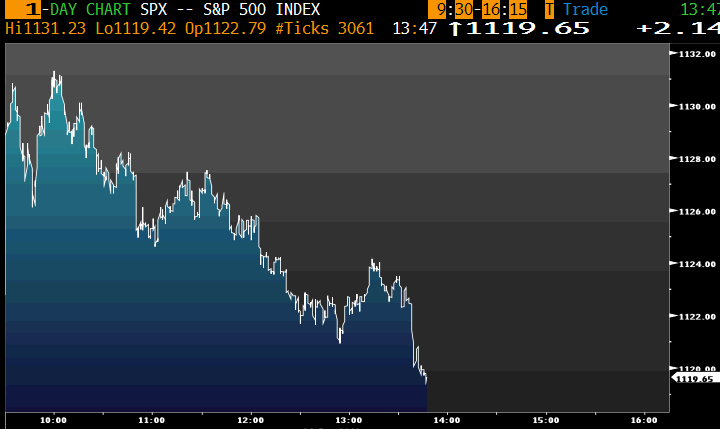
China's official announcement of their plan to reevaluate their yuan to eventually break its peg to the US Dollar has caused a ripple effect in global markets. US treasuries declined, and other major currencies rose against the US dollar. The chart above displays today's market decline in the S&P 500, as US companies react negatively to higher cost of Chinese goods.

The decision comes just after US Treasury Secretary Tim Geithner pressed China to allow their currency to naturally appreciate, thus allowing the US dollar to appear more attractive. The yuan revaluation benefits China as it gives them more purchasing power. China leads the export recovery, which provided enough reason for the Australian and New Zealand dollars to rally in response.

The US will benefit in one way from the yuan revaluation in trade. A weaker US dollar in the long run is likely to boost our exports. However, the dollar's demise has returned as major currencies rallied against the greenback. US consumers will eventually end up paying more for Chinese made goods, but don't mistake this for inflation - it's simply a trade balance.

Gold will rally as China shifts their holdings of US dollars. Most importantly, this shift has cause a decline in US Treasuries. China will not buy as much Treasuries as it did before to maintain the yuan's peg to the dollar.

Keep in mind that the yuan revaluation will be gradual, so there is still possibility that this news will subside and European debt concern will come back into play. Many economists say this is a risky move for the US as the cost of Chinese imports will rise. The Chinese realize the benefits for them, they are not so much concerned for the US. The announcement was bound to happen as the Chinese have long voiced concerns for the crumbling US economy.

Chinese industrial companies and commodities will benefit from this gradual revaluation, and demand will pick up from China. This should come as no surprise to those who are already invested in the China demand craze. Dantes Outlook was already prepared; the yuan appreciation just fuels the return on investment.

The big drag in the DOW today were those companies that rely on cheap imports from China.